Films › Production design
Kirikou and the Sorceress
Directed by Michel Ocelot, 1998
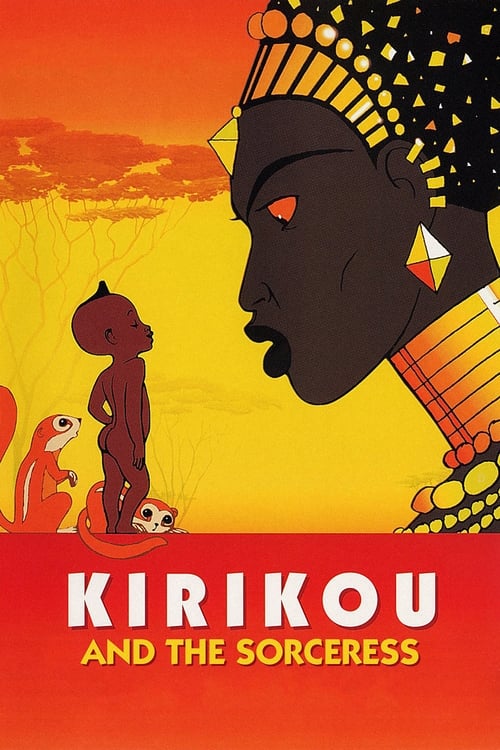
Michel Ocelot based Kirikou's visual world on West African textile patterns, mud architecture, and figurative traditions rather than the rounded, softened style common to children's animation of the period. Character designs keep bodies geometrically simple, flat color fields with minimal shading, but the village compounds, baobab trees, and Karaba's fortress are rendered with dense pattern work drawn from Senegalese and Malian sources Ocelot researched directly. The decision to depict villagers, including women, without the modesty conventions typical of Western animation aimed at children was deliberate and drew controversy in some markets, which Ocelot defended as ethnographic accuracy over imported prudishness. Animation was produced across French, Belgian, Hungarian, and Latvian studios on a modest budget, forcing a limited-motion style that pushed expressive weight onto silhouette and color contrast instead of frame-by-frame fluidity. For a filmmaker, the case demonstrates how research into a specific visual culture, rather than a generic fantasy aesthetic, gives an animated world specificity and repels the flattening effect of house style.
What to watch for
Notice how the flat, unshaded character rendering contrasts against the intricately patterned architecture, a hierarchy of visual detail that a small budget can still afford.
This product uses the TMDB API but is not endorsed or certified by TMDB.
Affiliate disclosure. Links on this page are affiliate links. As an Amazon Associate, Occupy Cinema earns from qualifying purchases, at no extra cost to you. Read the full policy.