Films › Editing
Meshes of the Afternoon
Directed by Maya Deren, Alexander Hammid, 1943
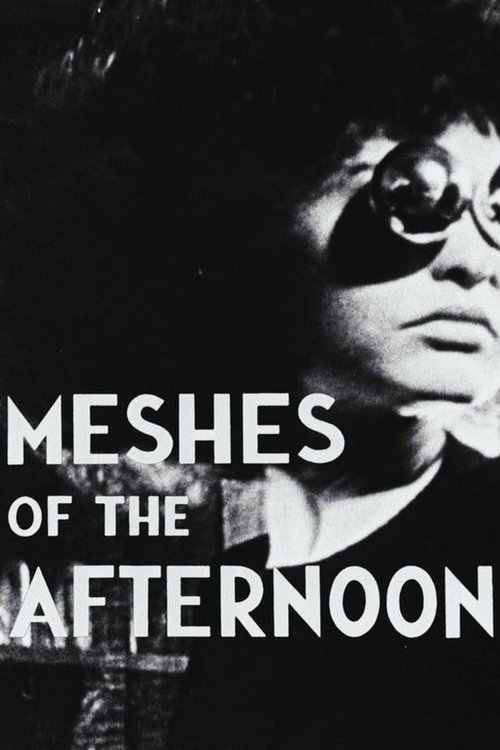
Maya Deren, editing her own footage shot with husband Alexander Hammid, constructed this film's dream logic entirely in the cutting room, using match cuts that carry a figure's foot from a garden path onto a sidewalk and then into a room, collapsing distinct physical spaces into a single continuous gesture. Deren repeats key actions, a hand reaching for a key, a knife, a flower, across multiple slightly varied takes and multiplies the protagonist's own image within single frames, an editing choice that dramatizes psychological fragmentation without any dialogue or intertitle. Her cutting deliberately breaks continuity rules of matched screen direction and eyeline to disorient rather than clarify spatial logic, a subversion only legible because she had mastered classical continuity first. The nonlinear structure loops back on its own opening images, refusing resolution and treating repetition itself as narrative content. Editors should study how Deren uses rhythm, repetition and self-multiplication as substitutes for plot causality, proving that an internal psychological structure can replace external story logic entirely if the cutting pattern stays rigorously consistent.
What to watch for
Watch the staircase and mirror sequences for how repeated match cuts multiply the protagonist within the same continuous action.
This product uses the TMDB API but is not endorsed or certified by TMDB.
Affiliate disclosure. Links on this page are affiliate links. As an Amazon Associate, Occupy Cinema earns from qualifying purchases, at no extra cost to you. Read the full policy.