Films › Directing
Spring in a Small Town
Directed by Fei Mu, 1948
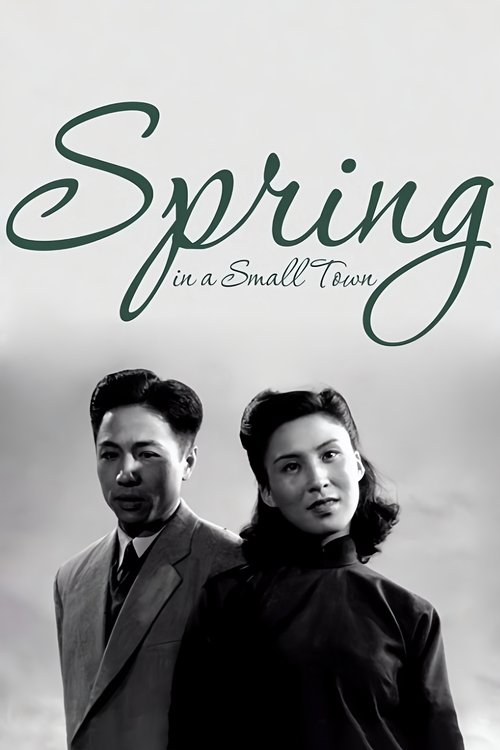
Fei Mu made this film in war-ravaged Shanghai with minimal resources, and instead of hiding those constraints he built the entire visual language around confinement, using a crumbling courtyard house as the only significant location. Camera movement is slow and deliberate, often drifting past characters rather than cutting between them, creating a sense of suppressed longing that matches the story's restrained adultery plot. Wei Wei's performance is shaped by blocking that keeps her physically between two men in nearly every shared frame, making spatial position carry the emotional subtext dialogue avoids. Fei uses voiceover from the wife's perspective sparingly, letting silence and gesture do the heavier lifting, a choice many later Chinese directors cite as foundational. Lighting is soft and diffused throughout, avoiding dramatic contrast even in emotionally charged scenes, which reinforces the film's tone of exhausted melancholy rather than crisis. For a filmmaker working with a single confined location and a small cast, this is essential study material: it proves that camera drift and blocking alone can generate tension a script never states outright.
What to watch for
Watch how the camera glides along the crumbling wall between the two male leads without ever cutting.
This product uses the TMDB API but is not endorsed or certified by TMDB.
Affiliate disclosure. Links on this page are affiliate links. As an Amazon Associate, Occupy Cinema earns from qualifying purchases, at no extra cost to you. Read the full policy.