Occupy Cinema › Awards
Danny Boyle Confronts the Machine Age at Venice
Addressing festival press on the Lido, Danny Boyle warned against the wholesale automation of culture, journalism, and early education.
By Occupy Cinema ·
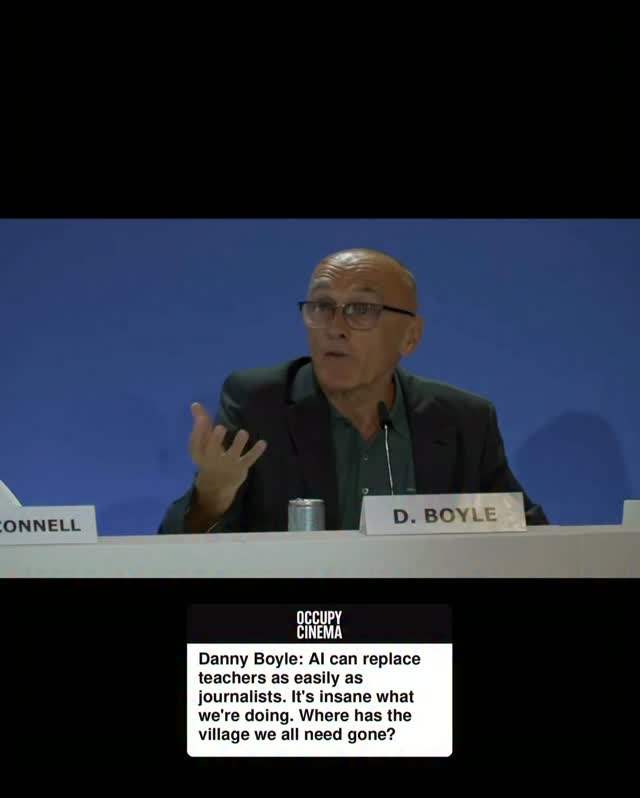
Cinema has spent the better part of two years reckoning with the financial and existential fallout of generative automation. In Venice, the conversation shifted from contract protections to the civic baseline. Speaking to reporters on the Lido, Oscar winner Danny Boyle delivered an unvarnished critique of silicon-driven disruption, drawing a direct parallel between the slow erosion of investigative journalism and the quiet dismantling of early childhood education.
The filmmaker did not couch his diagnosis in tech-utopian caveats. Boyle invoked his two-and-a-half-year-old grandchild, observing the care and human instinct demonstrated by nursery teachers before comparing their foundational labor to that of working reporters. Both professions, he argued, serve as the load-bearing pillars of civil society; both now face devaluation under an algorithm-first economic model. It is, he remarked, completely insane what the modern world is enabling under the banner of algorithmic scale.
The Cost of Replacing the Village
Hollywood knows the arithmetic all too well. Generative AI took center stage during the protracted dual strikes of 2023, where the Writers Guild of America and SAG-AFTRA fought fierce battles over residual structures and digital likeness rights, as tracked across coverage by Deadline. Studios sought efficiency margins; labor demanded guardrails against machine synthesis. Yet Boyle pushed past the usual guild bargaining points, focusing instead on the cultural commons. Where, he asked the press room, has the necessary village gone, and where are the unpopular truth-tellers who keep power accountable?
That tension sits squarely at the heart of James Graham's Ink, the lacerating Fleet Street stage drama chronicling the 1969 transformation of British media under Rupert Murdoch. Boyle, whose career has constantly pivoted between street-level pop dynamism and systemic institutional critique, pointed to revisions in the work that intentionally point directly toward our automated horizon. When the institutions that uncover hard truths are starved of revenue and converted into programmatic click syndication, the civic fabric disintegrates far faster than any balance sheet can record.
Craft, Accountability, and Human Friction
Boyle's career has long served as a bellwether for technology deployed in service of human friction rather than in place of it. From capturing late-nineties London on low-resolution Canon XL1 digital video cameras for 28 Days Later to executing complex kinetic edits on studio budgets, the director has consistently weaponized technological innovation to intensify human emotion, not to cut payroll costs. As reported by Variety, the current festival circuit has become an ideological battleground over whether generative models will assist filmmakers or merely accelerate corporate austerity.
The economic stakes across international markets remain steep. Independent cinema relies on specialized crafts: set dressers, script supervisors, fact-checkers, and local researchers whose work resists simple prompt generation. By framing the crisis around teachers and journalists, Boyle reframed the technical argument into a broader societal emergency. A culture that views mentorship and adversarial reporting as expensive overhead is a culture destined to inherit synthetic answers to urgent human dilemmas.
Boyle's warning carries weight because it cuts through Hollywood's customary tech enthusiasm. The cinema was forged in the industrial age, yet its vitality has always relied on the messy, inefficient, and deeply personal labor of flesh-and-blood observers. If the industry chooses short-term margin expansion over human mentorship, it will not just lose its workforce; it will lose the collective intelligence that makes telling stories necessary in the first place.
Related reading: Cinema Treasures: A New Look at Classic Movie Theaters.