Occupy Cinema › FEATURED
When Joaquin Phoenix Brought River Phoenix to the Oscar Stage
A $55 million gamble produced $1.07 billion at the box office, eleven Oscar nominations, and one of the most personal acceptance speeches in Academy history.
By Occupy Cinema ·
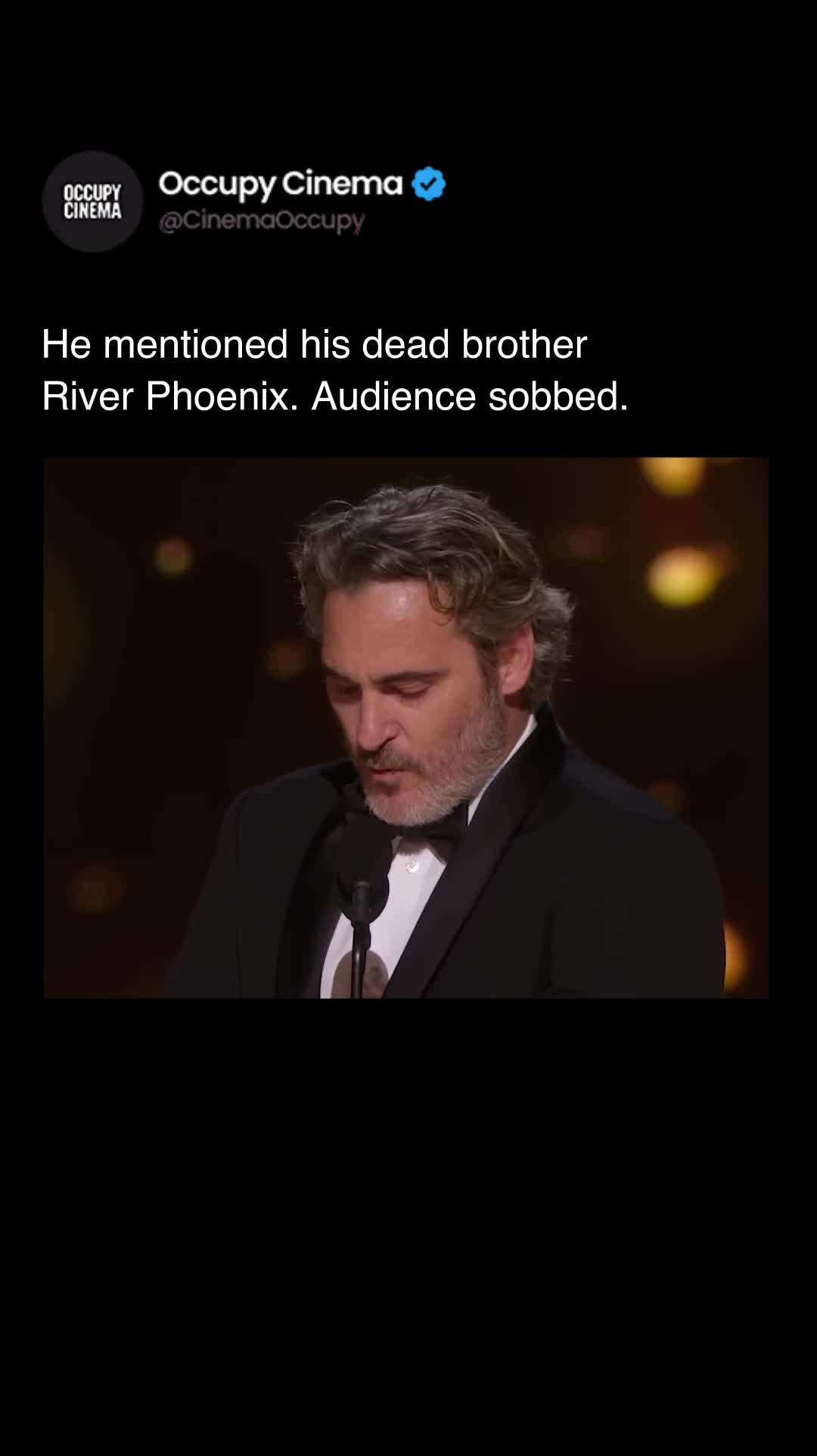
On February 9, 2020, inside the Dolby Theatre in Hollywood, Joaquin Phoenix stepped up to the podium to collect the Academy Award for Best Actor. Warner Bros. had taken a modest $55 million gamble on director Todd Phillips and his dark, psychological character study Joker. The theatrical results were staggering. The film grossed over $1.074 billion globally, becoming the highest-grossing R-rated movie in cinematic history at the time. It secured eleven Academy Award nominations, leading the field for the 92nd ceremony. Yet the defining moment of that historic awards season did not concern box office figures or studio achievements. It came in the final seconds of Phoenix's acceptance speech, when he shattered decades of quiet self-preservation to speak about his late brother, River.
"When he was 17, my brother wrote this lyric," Phoenix told the audience, his voice faltering slightly as tears welled in his eyes. "He said, 'Run to the rescue with love and peace will follow.'" The line belonged to River Phoenix, who died in October 1993 at age 23 outside The Viper Room in West Hollywood. For nearly thirty years, Joaquin Phoenix had maintained a strict barrier regarding his grief, routinely declining to discuss River in red-carpet interviews or television appearances. Invoking his brother's words on the most visible stage in entertainment was a rare, striking moment of personal exposure from an actor known for fierce privacy.
The path to that Oscar podium was paved with unprecedented commercial numbers. Warner Bros. originally sought to mitigate its risk by bringing on co-financiers Bron Creative and Village Roadshow, each taking an equity stake in the production. The studio was initially hesitant about producing an origin story that abandoned traditional comic book spectacle in favor of gritty 1970s character study dynamics reminiscent of classic psychological cinema. That skepticism evaporated when Joker premiered at the 76th Venice International Film Festival in August 2019, where it stunned attendees and earned the top prize, the Golden Lion. According to tracking reported by Deadline, opening weekend projections started in the $60 million range before climbing rapidly. The film eventually launched to a massive $96 million domestic opening in October 2019, setting a record for the month and establishing instant momentum for an unprecedented awards run.
The craft behind Phoenix's portrayal was as rigorous as its box office execution. To play Arthur Fleck, Phoenix underwent an extreme physical transformation, losing 52 pounds under strict medical direction. That drastic weight loss directly affected his body language, giving Fleck a skeletal, erratic posture. Cinematographer Lawrence Sher captured this physical degradation using wide lenses in tight urban spaces around New York and New Jersey, framing Fleck against oppressive concrete architecture. Meanwhile, Icelandic composer Hildur Guðnadóttir wrote the haunting cello score prior to filming, directly off reading the script. That music was played on set during shooting, allowing Phoenix to improvise key character moments including the famous bathroom dance scene, which was originally scripted as a standard linear narrative moment.
An Unconventional Oscar Campaign
Throughout the 2019 and 2020 awards circuit, Phoenix subverted typical promotional strategies. Modern Oscar campaigns are traditionally tightly managed operations, designed to present candidates as pristine ambassadors for studio brands. Phoenix took a radically different path. Industry coverage in Variety documented how Phoenix consistently redirected his time at the microphone toward systemic issues, animal rights, and social justice during accepts at the Golden Globes, Critics' Choice Awards, Screen Actors Guild Awards, and BAFTAs. By the time final voting opened for the Academy of Motion Picture Arts and Sciences, Phoenix was the unquestioned frontrunner, having swept every major precursor honor in the lead-up to Oscar night.
His Oscar win represented a historically rare event in Academy history. Phoenix became only the second actor to win an Oscar for playing the character of the Joker, following Heath Ledger, who earned a posthumous Best Supporting Actor award for Christopher Nolan's The Dark Knight in 2009. The distinction underscored the flexibility of modern comic book characters when approached by distinct directors and actors. Ledger's performance was an exercise in precise, ideological chaos, whereas Phoenix delivered a visceral exploration of mental illness, social isolation, and institutional failure.
River Phoenix's legacy hung over the achievement in subtle ways. Before his death, River was regarded as one of the finest young actors of his generation. He earned an Academy Award nomination for Best Supporting Actor at age 18 for Sidney Lumet's Running on Empty in 1988, and delivered legendary performances in films like Stand by Me in 1986 and Gus Van Sant's My Own Private Idaho in 1991. Joaquin has often noted that River was the person who encouraged him to return to acting as a child after seeing his talent, famously sitting him down to watch Martin Scorsese's Raging Bull and telling him that acting was what he was meant to do with his life.
The Industrial Legacy of Joker
The financial and critical success of Joker reshaped executive thinking across Hollywood. Prior to its release, major studios rarely assigned mid-tier budgets to dark, character-driven adult dramas based on high-value corporate intellectual property. Joker demonstrated that audiences would turn out in record numbers for uncompromising, vision-led cinema without standard visual effects sequences. According to analysis from The Hollywood Reporter, the success of the film altered long-term franchise development strategies across multiple studios, proving that stand-alone, director-driven projects could coexist alongside interconnected cinematic universes.
The 92nd Academy Awards were already memorable for breaking decades of historical precedent, most notably when Bong Joon-ho's Parasite became the first non-English language film to win Best Picture. In that landscape, Phoenix's victory served as the emotional centerpiece of the broadcast. His speech addressed human disconnection, systemic greed, and the necessity of second chances, avoiding self-congratulation in favor of moral urgency.
When Phoenix concluded his speech with River's quote, the gesture felt like a long overdue reconciliation between his personal history and his public success. It was not merely a tribute to a dead brother, but an acknowledgment of the shared creative spark that launched his own career. In an industry defined by box office tracking, campaign budgets, and polished public relations strategies, Phoenix delivered a moment of total vulnerability. The legacy of Joker extends beyond its $1 billion box office record and its awards count. It remains a testament to what happens when raw artistic instinct is allowed to occupy the biggest stage in cinema.