Occupy Cinema › FEATURED
Oscar Night's Bitter Pill: The Robin Williams Story
A look back at Robin Williams' complicated relationship with the Academy Awards, from early snubs to eventual triumph, and what it reveals about Hollywood's recognition machine.
By Occupy Cinema ·
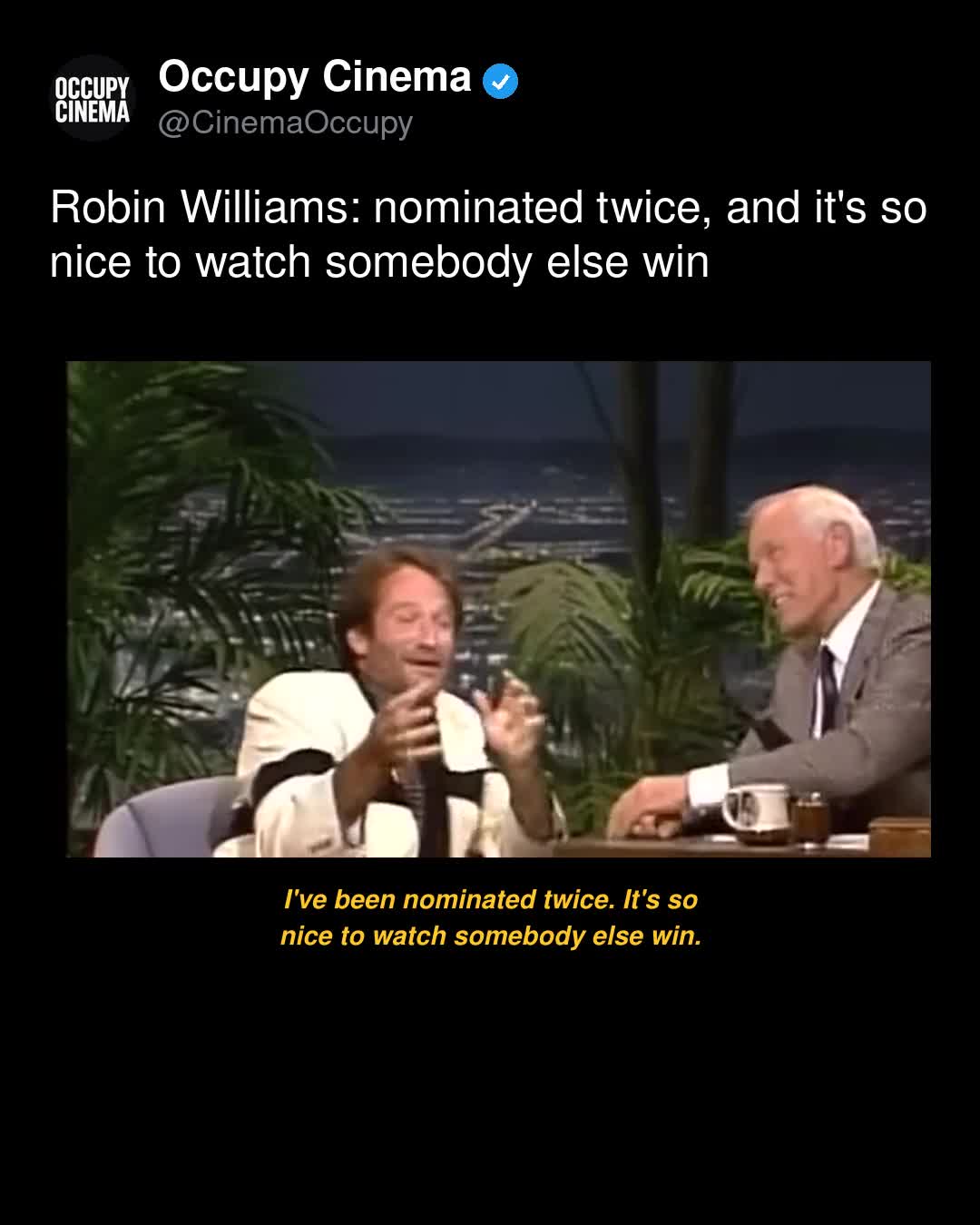
Hollywood’s awards season is a high-stakes arena, and few figures have embodied its triumphs and frustrations quite like Robin Williams. His early Oscar journey offers a stark lesson in the industry’s unpredictable nature, a narrative of repeated near-misses before a definitive win. The legend of Williams’ Oscar snubs, particularly his candid remarks on The Tonight Show in January 1991, provides a potent reminder that even the most celebrated talents navigate a labyrinth of expectation, competition, and often, disappointment, under the intense glare of the world’s cameras.
The conversation with Johnny Carson, which aired on January 10, 1991, saw Williams promoting Awakenings, a film that would soon earn him his third Best Actor nomination. His self-deprecating humor, a trademark of his public persona, was on full display as he quipped about the experience of losing. “I have been nominated twice. It is so nice to watch somebody else win. They read the name and they keep the camera on you and you are supposed to look happy.” This remark, delivered with characteristic wit, encapsulated the peculiar pressure placed upon nominees, especially those who have experienced the sting of defeat multiple times.
Before Awakenings, Williams had already been recognized by the Academy for two highly acclaimed performances: Adrian Cronauer in 1987’s Good Morning, Vietnam and John Keating in 1989’s Dead Poets Society. Both roles showcased his extraordinary range, blending his signature improvisational energy with profound dramatic depth. Good Morning, Vietnam, directed by Barry Levinson, saw him portray a fast-talking, irreverent DJ bringing subversive humor to troops during the Vietnam War. It was a commercial success, grossing over $123 million domestically, and earned Williams his first Oscar nod. He lost that year to Michael Douglas for Wall Street.
Two years later, Dead Poets Society, under the direction of Peter Weir, presented Williams as an unconventional English teacher inspiring his students through poetry and rebellion. The film was a critical and commercial darling, securing four Oscar nominations, including Best Picture and another Best Actor for Williams. It grossed over $235 million worldwide. Despite his moving portrayal, he was ultimately bested by Daniel Day-Lewis for My Left Foot. These consecutive nominations affirmed his status as a serious dramatic actor, yet the ultimate prize remained elusive.
His third nomination came swiftly, for Penny Marshall’s Awakenings. In this poignant drama, Williams played Dr. Malcolm Sayer, a compassionate neurologist discovering a revolutionary treatment for catatonic patients. The film, co-starring Robert De Niro, was praised for its emotional depth and strong performances. It received three Oscar nominations, including Best Picture, but Williams again found himself watching another actor take the stage; this time, it was Jeremy Irons for Reversal of Fortune. Three nominations, three losses. The pattern was clear, and it contributed to a narrative of Williams as a perennial bridesmaid at the Academy Awards.
The Long Road to Gold
The repeated snubs for roles that were widely praised, and for films that performed well both critically and commercially, underscored a peculiar tension in Williams’ career. He was a comedic genius, but his dramatic work often struggled to garner the ultimate industry validation. This phenomenon is not uncommon in Hollywood; comedic actors frequently face an uphill battle when seeking recognition for their serious performances, often being pigeonholed by their earlier, lighter roles. Williams, however, consistently defied such categorization, proving his dramatic chops with each successive film.
The tide finally turned seven years after his last loss. In 1998, Robin Williams won the Academy Award for Best Supporting Actor for his role as Dr. Sean Maguire in Gus Van Sant’s Good Will Hunting. This victory was widely celebrated, not just for the performance itself, but as a recognition of his entire body of work and his persistent efforts to push beyond comedic boundaries. His acceptance speech was a memorable blend of humor and genuine emotion, a fitting culmination to a long and often frustrating awards journey. The film, which also launched the careers of Matt Damon and Ben Affleck, was a critical and commercial triumph, grossing over $225 million worldwide and securing two Oscars from nine nominations.
Williams’ journey to the Oscar stage highlights the complex interplay of performance, public perception, and industry politics that defines awards season. His early losses were not for lack of talent or impact; indeed, Good Morning, Vietnam, Dead Poets Society, and Awakenings remain cherished films in his filmography and continue to resonate with audiences. They are examples of Williams’ profound ability to connect with humanity in its most vulnerable and inspiring forms. The Academy, an institution often criticized for its slow recognition of certain talents or genres, eventually caught up to what audiences and critics already knew: Robin Williams was an extraordinary actor whose range transcended easy classification.
Beyond the Statuette
While the Oscar win for Good Will Hunting was a significant moment, it is important to contextualize its place within Williams' broader legacy. His impact on cinema extends far beyond any single award. His filmography is dotted with iconic performances, from the animated Genie in Disney's Aladdin to Mrs. Doubtfire, showcasing an unparalleled versatility. The awards narrative, while compelling, is just one facet of a career defined by innovation, boundless energy, and a deep well of empathy.
The industry's recognition of Williams often came with a delay, a testament to how established perceptions can sometimes lag behind evolving artistry. His story serves as a perennial reminder that while awards are significant markers of achievement, they do not singularly define a career's worth or impact. The enduring power of his performances, particularly those for which he was initially overlooked, continues to speak volumes about his talent. As The Hollywood Reporter often notes, the legacy of a star like Williams is measured not just in gold statues, but in the indelible mark left on culture and the hearts of millions.
Robin Williams' Oscar journey, from his wry observations on Carson to his eventual triumph, is a microcosm of Hollywood itself: a place of immense talent, fierce competition, and sometimes, a slow but sure path to recognition. His early nominations for films like Dead Poets Society and Awakenings were deserved, even if the win eluded him then. His eventual victory was a collective sigh of relief and celebration for an artist who had given so much, for so long. It affirmed that sometimes, even in the glittering, competitive world of the Oscars, persistence and undeniable talent eventually find their due.