Occupy Cinema › People
When Anthony Bourdain and Barack Obama Turned a Six-Dollar Hanoi Dinner into Cinematic History
Inside the production mechanics, documentary craft, and lasting cultural footprint of the most famous table in modern nonfiction television.
By Occupy Cinema ·
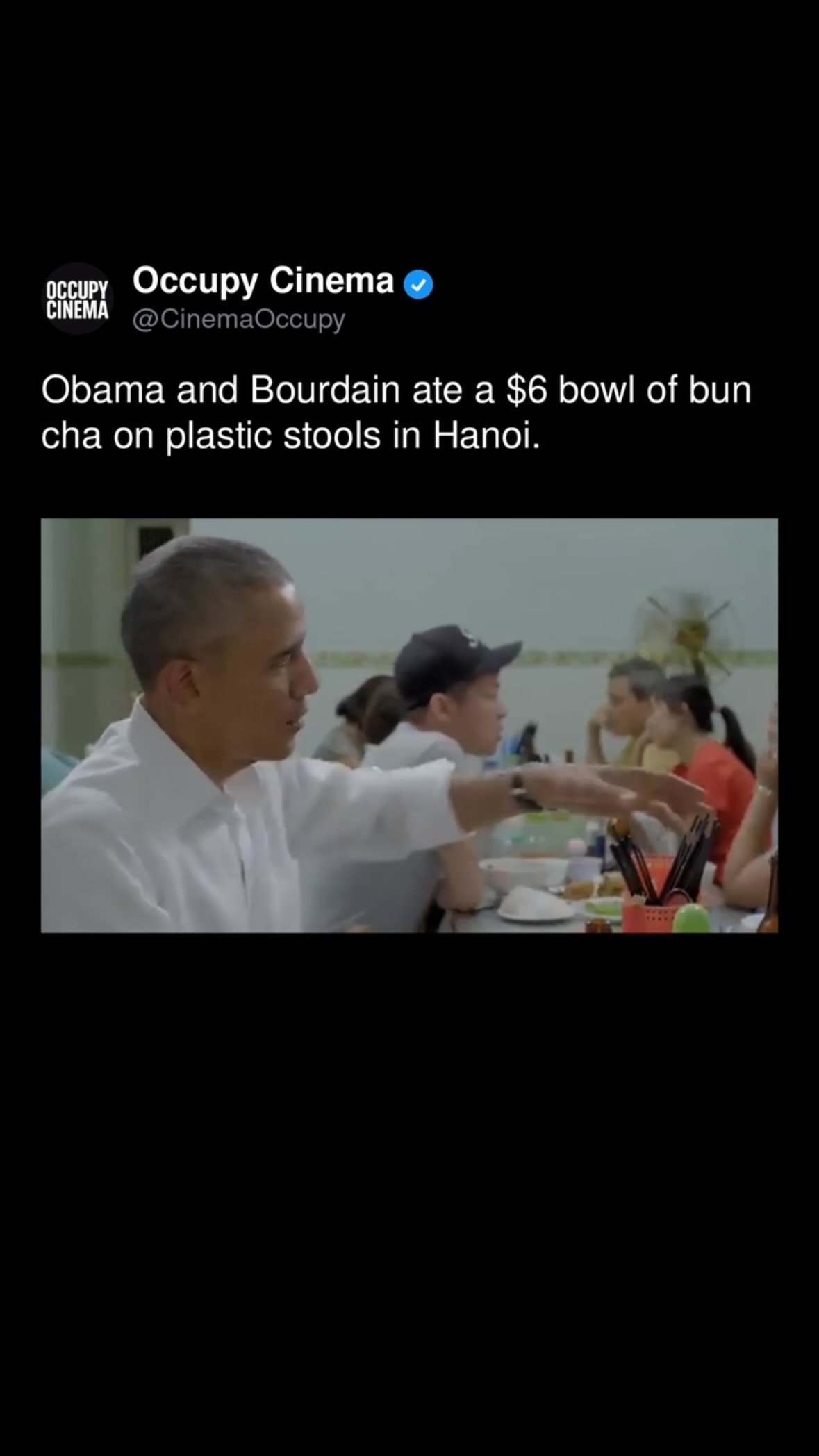
When the season eight premiere of Anthony Bourdain: Parts Unknown aired on CNN in September 2016, cable news programming was deep in the throes of an aggressive election cycle. Bourdain countered that noise with quiet cinema. Sitting on low plastic stools at Bún Chả Hương Liên in Hanoi, Vietnam, Bourdain shared cold local beer and grilled pork noodles with President Barack Obama. The entire bill came out to six dollars. What unfolded was not a standard television interview or a staged photo op, but a masterclass in nonfiction visual storytelling that reframed political diplomacy through the lens of pure culinary verité.
Capturing a sitting United States president inside a cramped, working-class storefront required months of high-level logistical coordination between the White House Secret Service detail and Bourdain’s longtime production company, Zero Point Zero Production. Despite the immense security footprint outside the shop on Le Van Huu Street, the production team maintained absolute aesthetic integrity inside. There were no lighting rigs blocking the aisles, no massive boom mics overhead, and no cordoned-off private dining rooms. The crew relied on small-footprint cinema cameras, capturing the natural sodium-vapor glow of the room and preserving the ambient street noise filtering in from the alleyways.
The Cinematography of Street-Level Diplomacy
The visual language of the episode relied on intimacy rather than polish. Zero Point Zero’s camera department, known for shaping the aesthetic grammar of modern travel television, used lightweight digital camera packages to operate in tight quarters. By keeping the lenses wide and close to the subjects, the footage placed the viewer directly on the plastic stool next to them. Bourdain’s direction favored unvarnished reaction shots over television gloss, capturing Obama maneuvering rice noodles with chopsticks and discussing childhood memories of Indonesian street food, including fried carp caught from mountain channels in Puncak.
That approach completely subverted the visual tropes of White House press pool coverage. As reported across coverage in The Hollywood Reporter and Variety during the series run, Parts Unknown operated more like an ongoing auteur documentary project than a weekly broadcast magazine show. The Hanoi episode earned universal critical acclaim because it treated the commander-in-chief not as an untouchable dignitary, but as a guest at an everyday table, completely stripped of political artifice.
The Business and Afterlife of Nonfiction Storytelling
The episode remains a high-water mark for the CNN Original Series initiative, which built a lucrative programming pillar around Bourdain’s creative freedom. The series secured twelve Primetime Emmy Awards across its run, setting a benchmark that major streaming platforms would chase for the subsequent decade. When director Morgan Neville later examined Bourdain’s life and craft in the 2021 documentary Roadrunner, the Hanoi sequence stood out as the apex of Bourdain’s talent for using food as an equalizer and a narrative bridge across cultures.
Today, the physical artifacts of that meal reside under glass at Bún Chả Hương Liên, preserved like museum relics by the family who runs the restaurant. While Bourdain publicly questioned the commodification of the table in the years following the shoot, the display speaks to the singular cultural resonance of the broadcast. In an era dominated by hyper-rehearsed media appearances and calculated public relations campaigns, six dollars and two stools in Hanoi proved that observational filmmaking still has the power to stop the world and simply observe.
Related reading: Reflections: Twenty-One Cinematographers at Work.