Occupy Cinema › FEATURED
The $119 Million Whisper: How Sofia Coppola Built an Indie Landmark Out of Restraint
Sofia Coppola made Lost in Translation for just $4 million. Twenty-one years later, its famous silent farewell remains a masterclass in cinematic restraint and character privacy.
By Occupy Cinema ·
Focus Features released Lost in Translation in the autumn of 2003. The film carried a modest production budget of roughly four million dollars and proceeded to generate over 119 million dollars in worldwide box office revenues. That represents an extraordinary return on investment for an art-house production, establishing a high-water mark for specialty distribution during the early two-thousands. Yet more than two decades after its initial theatrical run, the film is remembered not for its financial ledger, but for a single unscripted moment on a Tokyo street where the soundtrack falls quiet and the audience is denied explicit narrative closure.
Director Sofia Coppola mounted the project as her sophomore feature following her acclaimed 1999 debut, The Virgin Suicides. Operating with minimal studio interference, Coppola wrote the screenplay with Bill Murray specifically in mind for the lead role of Bob Harris, an aging American movie star filming a whiskey commercial in Japan. Tracking down Murray required months of persistent outreach, as the actor famously operated without standard talent representation. When Murray finally arrived in Tokyo without a signed contract, production commenced under an aggressive 27-day shooting schedule. Scarlett Johansson, who was just seventeen years old at the time of filming, was cast as Charlotte, a young university graduate grappling with existential drift.
The visual grammar of Lost in Translation was forged through lightweight, run-and-gun filmmaking techniques that prioritized authentic atmosphere over heavy studio equipment. Cinematographer Lance Acord utilized Aaton 35mm cameras paired with high-speed Kodak film stock, enabling the crew to shoot largely with available ambient light across the neon cityscape of Shinjuku and Shibuya. Without extensive municipal permits or massive production footprints, the team navigated actual locations, including the Park Hyatt Tokyo, which served as both the physical backdrop and the psychological architecture of urban isolation. The shooting strategy required rapid adaptability, allowing the camera to capture spontaneous interactions between the actors and the surrounding environment with documentarian intimacy.
The Architecture of Creative Restraint
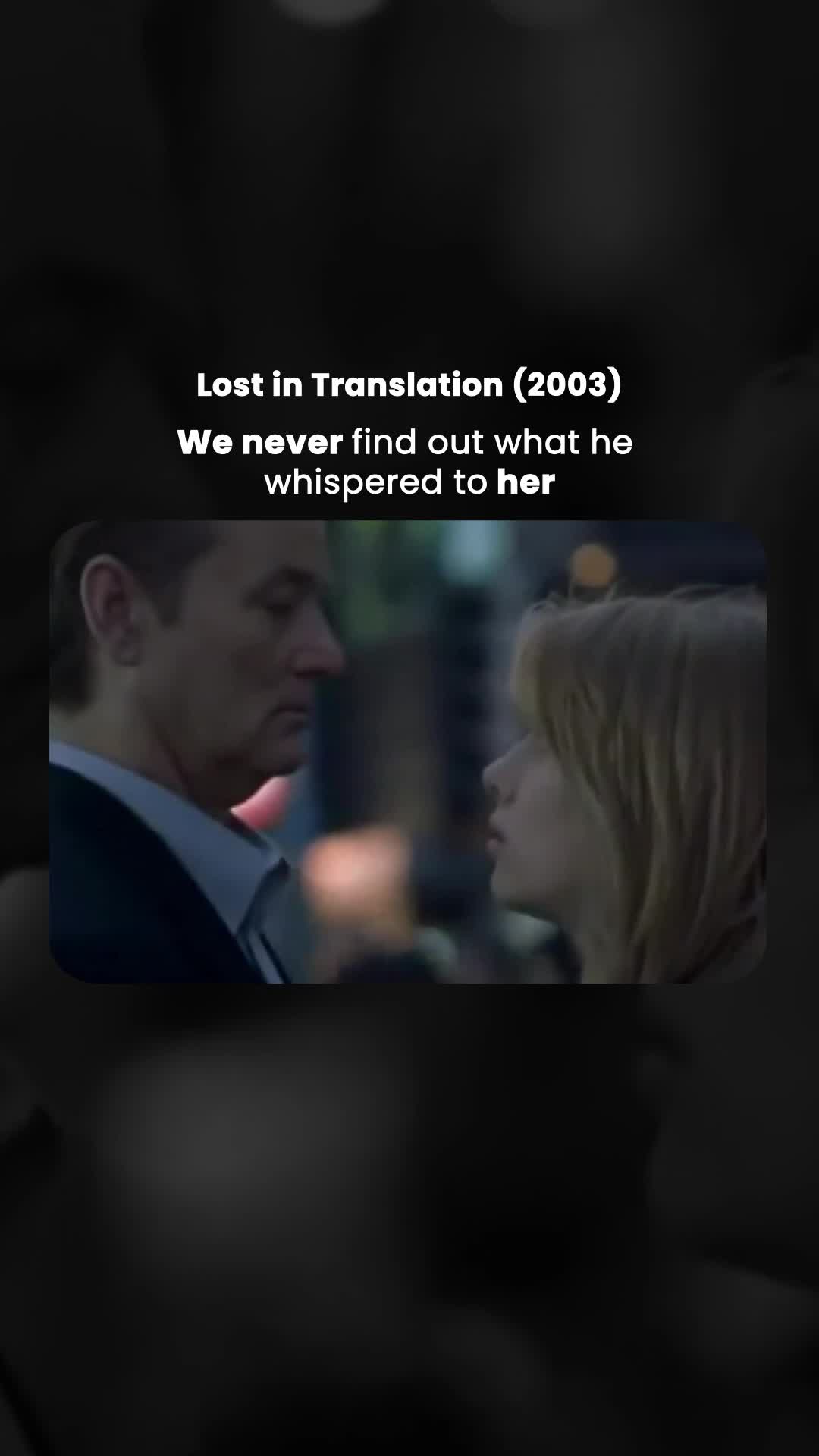
This flexible approach culminated in the iconic final sequence on the streets of Tokyo. As Bob Harris prepares to travel to the airport, he spots Charlotte in a crowded pedestrian throng, steps out of his taxi, and embraces her for a final farewell. During the exchange, Murray leans in and whispers an unheard message into Johansson's ear. Coppola intentionally omitted specific dialogue for the line in the screenplay, leaving the exact wording entirely to Murray's discretion during the take. On set, neither the director nor the sound recordists were made aware of what Murray said. Coppola chose to retain the muffled audio mix in post-production, preserving the mystery and ensuring that Johansson's visible emotional response was rooted in a private reality rather than a pre-scripted cue.
The decision to withhold the dialogue ran counter to standard Hollywood editing practices, which usually demand total clarity and explicit exposition for emotional climaxes. According to industry trade coverage from The Hollywood Reporter, Focus Features backed Coppola's artistic autonomy, recognizing that the film's strength lay in its elliptical, mood-driven storytelling. The gamble paid off immensely across the 2003 awards circuit. The film garnered four Academy Award nominations, including Best Picture, Best Director for Coppola, and Best Actor for Murray. Coppola ultimately won the Oscar for Best Original Screenplay, solidifying her status as one of the defining auteur voices of her generation while demonstrating that restraint could achieve mainstream critical and commercial success.
Coverage across platforms like IndieWire has consistently cited Lost in Translation as a turning point for American independent cinema in the digital transition era. By combining high-concept emotional dislocation with low-budget physical production, the film proved that character studies could attract wide audiences without relying on traditional narrative mechanics. The film's success validated the specialty distribution model championed by Focus Features executives, who mastered platform release strategies, opening the film in limited engagements before rolling out nationwide as word-of-mouth momentum built.
The Business of Ambiguity in Modern Cinema
In contemporary Hollywood, narrative ambiguity has become an increasingly endangered creative choice. Modern studio filmmaking heavily emphasizes explicit world-building, post-credits teasers, and definitive narrative explanations designed to feed transmedia franchises and algorithmic recommendation engines. In contrast, Lost in Translation stands as an enduring monument to the power of artistic understatement. Coppola understood that explaining the exact words whispered by Murray would diminish the emotional weight of the scene. By withholding that information, the narrative forces the viewer to project their own feelings onto the screen, transforming a private character moment into a universal cinematic memory.
The musical landscape of the film further amplified this atmospheric ambiguity. Music supervisor Brian Reitzell collaborated closely with Coppola to craft a soundtrack featuring atmospheric shoegaze and dream-pop tracks, including original instrumental compositions by Kevin Shields of My Bloody Valentine, as well as iconic tracks from The Jesus and Mary Chain and Air. The sonic texture of the film worked in tandem with Lance Acord's soft lighting and naturalistic framing, creating a sensory environment where silence and ambient sound carried as much narrative weight as written dialogue. Every craft department operated in service of an overarching emotional mood rather than mechanical exposition.
The financial legacy of Lost in Translation remains equally instructional for contemporary producers and distributors. Produced for four million dollars, the film generated a massive theatrical return while launching Scarlett Johansson into international stardom and earning Bill Murray some of the highest critical acclaim of his long career. The film's enduring popularity proves that audiences do not always require complete resolution or over-explained plot points to connect with a story. When trust is established between a director, their cast, and the audience, an unheard whisper can prove far more powerful than any scripted speech.
Ultimately, the lasting brilliance of Lost in Translation rests in its respect for human privacy within a visual medium. In an era where every detail of production is dissected on social media and analyzed by online commentators, Sofia Coppola's quiet climax remains untouched. By leaving those final words between Bob and Charlotte on the streets of Tokyo, the film asserts that some human connections are too intimate to be broadcast to the world. That refusal to explain everything is precisely why the film continues to resonate with viewers more than twenty years after its release.