Occupy Cinema › Development
Why Ryan Gosling's Project Hail Mary Is Bet-the-Farm Sci-Fi for Amazon MGM
Behind-the-scenes glimpses of Lord and Miller's space epic reveal a massive practical rig for its alien co-star, signaling an ambitious, craft-first gamble for theatrical sci-fi.
By Occupy Cinema ·
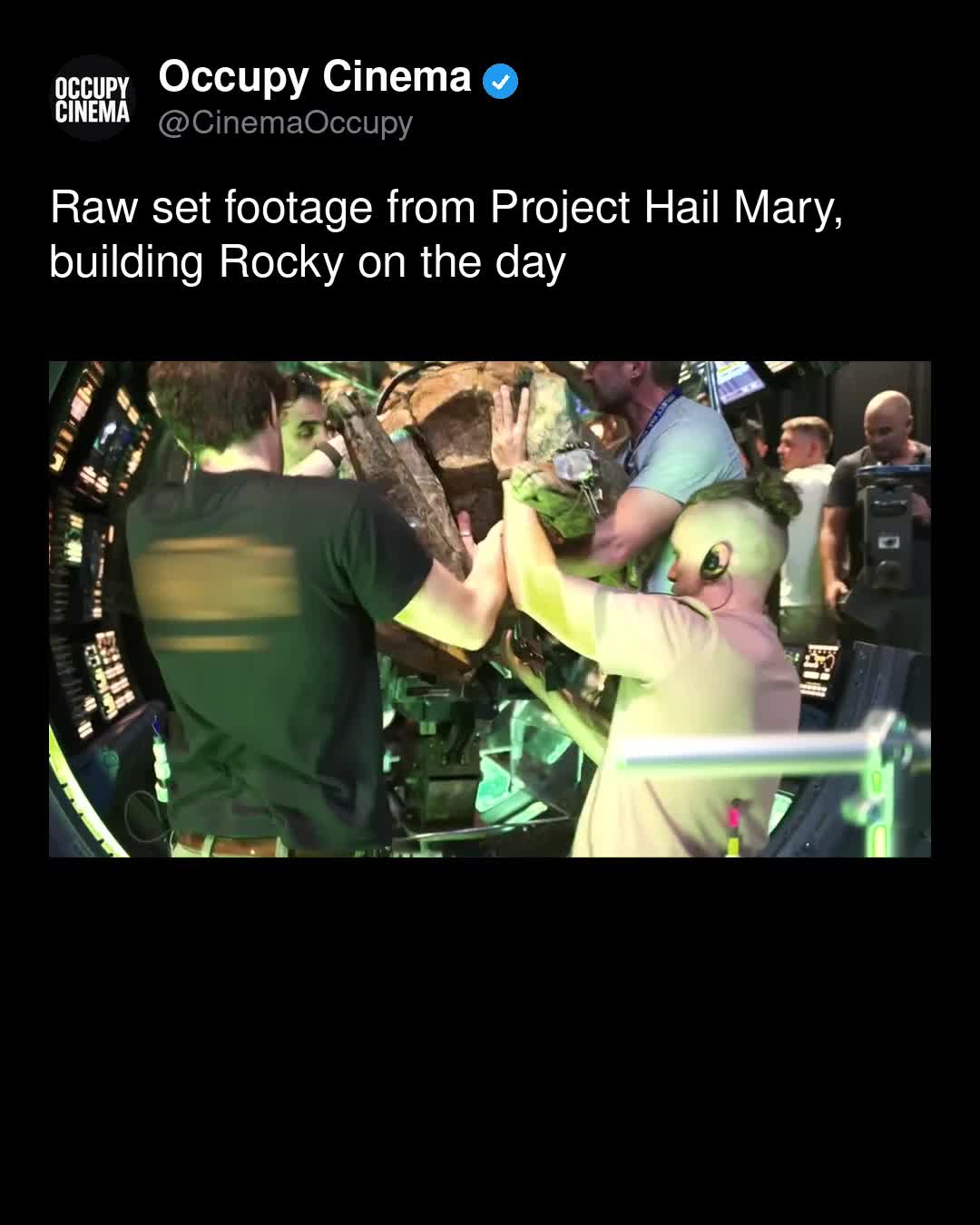
Amazon MGM Studios is playing for keeps with its upcoming adaptation of Andy Weir's Project Hail Mary. In an era where studio tentpoles default to antiseptic green stages and tennis balls on sticks, glimpses from the production show directors Phil Lord and Christopher Miller taking a decidedly tactile approach. At the center of the set sits a physical, fully articulated stand-in for Rocky, the xenomorphic, five-legged engineer who forms an unlikely bond with Ryan Gosling's lone-survivor protagonist Ryland Grace. It is a vital craft choice that directly mirrors the hard-science ethos that made the property a blue-chip acquisition in the first place.
The Shadow of The Martian and the Math of Big Sci-Fi
Hollywood has spent a decade chasing the lightning in a bottle that Ridley Scott captured with Weir's debut novel in 2015. The Martian pulled $630 million worldwide on a disciplined $108 million production budget, proving that rigorous orbital mechanics and high-concept survivalism could play to mainstream multiplexes. When MGM outbid multiple suitors in early 2020 to land the screen rights for Weir's follow-up book, paying a reported seven figures before the manuscript even hit bookshelves, the mandate was clear: duplicate that formula at maximum scale. With Drew Goddard returning to adapt the screenplay, the creative continuity is deliberate and bankable.
According to production reports tracked by Deadline, the investment here is massive, with estimates placing the production budget well north of $150 million. That figure makes Project Hail Mary one of the premier test cases for Amazon MGM's post-merger theatrical strategy. The studio committed to putting massive original and adapted IP directly into cinemas before sliding it onto streaming queues. For an operation under pressure to prove that tech-company ownership can sustain real-deal cinematic showmanship, the execution on the studio floor matters immensely.
Physical Presence Over Post-Production Safety Nets
The choice to build a physical proxy for Rocky on set is more than just behind-the-scenes trivia; it is a fundamental acting and lighting decision. Shot by cinematographer Greig Fraser, whose work on Dune and The Batman established him as the gold standard for tactile genre lighting, the production relies on physical volume and genuine bounce light. By placing an articulated, textured proxy inside the spaceship module opposite Gosling, Fraser can light an actual physical volume while Gosling has immediate spatial cues and physical eyelines to ground his performance.
This methodology has historical pedigree. Decades ago, Jim Henson and Frank Oz proved that puppetry elevated on-screen scene partners to emotional heights digital tracking markers rarely match. More recently, productions covered by The Hollywood Reporter have highlighted how practical stand-ins consistently yield more natural micro-expressions from A-list leads. In Weir's novel, the communication between Grace and Rocky relies on musical chords, harmonic intervals, and spatial sign language. Having a physical counterweight on set allows Gosling to react to weight, friction, and presence in real time, preventing the detachment that so often drags down VFX-heavy chamber pieces.
Lord and Miller's Live-Action Reckoning
For Lord and Miller, Project Hail Mary represents their first live-action directorial feature since their abrupt exit from Solo: A Star Wars Story in 2017. While the duo has spent the intervening years cementing their reign as animation titans via the Oscar-winning Spider-Verse franchise, their return to live-action studio filmmaking comes with significant stakes. Their signature tone, balancing improvisational warmth with structural precision, must now fit within the rigorous physics of Weir's universe and Fraser's disciplined visual architecture.
The takeaway from early production glances is that Amazon MGM is letting its creative leads build a world with dirt, metal, and real mass under its fingernails. Pure-concept sci-fi needs tangibility to survive its own exposition. If Gosling's isolation inside the Hail Mary feels heavy, exhausting, and grounded in mechanical reality, the audience will follow him anywhere, even into a deep-space conversation with a five-legged creature made of stone.