Occupy Cinema › FEATURED
The Billion-Dollar Selfie: How Ellen’s 2014 Oscar Stunt Marked the High-Water Mark of Live TV
Ten years ago, Ellen DeGeneres brought Twitter to its knees with a Samsung Galaxy Note 3. Inside the numbers, the sponsorship, and why live broadcast television will never replicate the moment.
By Occupy Cinema ·
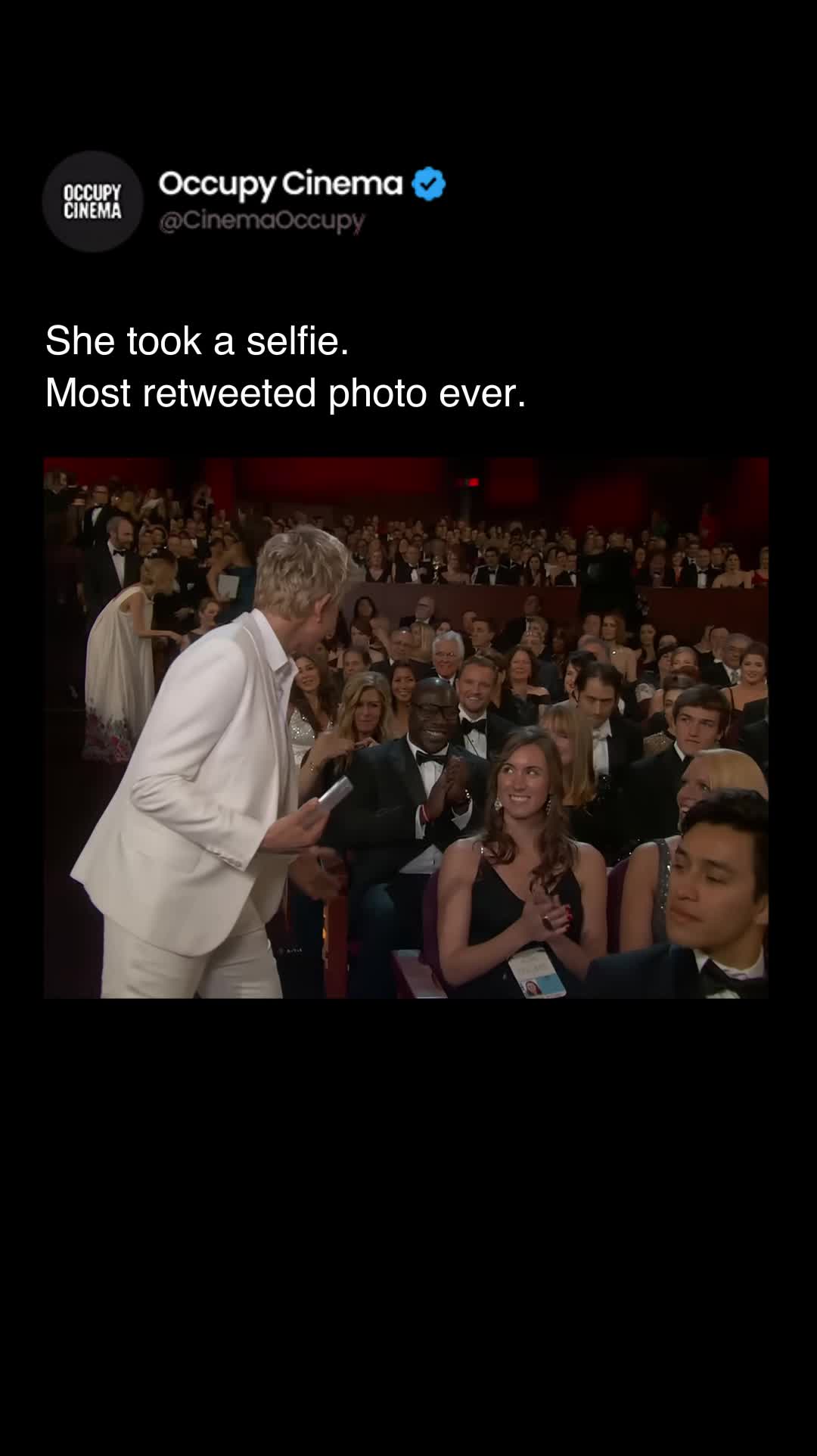
On March 2, 2014, the 86th Academy Awards produced a television broadcast that remains a watershed moment for modern media economics. ABC was charging an average of $1.8 million for a 30-second commercial spot during the telecast. Electronics giant Samsung had invested an estimated $20 million into total sponsorship across the evening, including traditional spots and subtle product placements. Midway through the ceremony at the Dolby Theatre in Hollywood, host Ellen DeGeneres stepped down into row C of the auditorium armed with a white Samsung Galaxy Note 3 phablet. What occurred over the next sixty seconds changed corporate sponsorship, live television production, and internet infrastructure.
DeGeneres initially intended to take a simple self-portrait with Meryl Streep. As the room reacted, the frame expanded organically. Bradley Cooper stepped forward to handle the device to fit more talent into the shot, extending his arm while DeGeneres, Streep, Julia Roberts, Jennifer Lawrence, Brad Pitt, Angelina Jolie, Jared Leto, Channing Tatum, Kevin Spacey, and Lupita Nyong'o squeezed together. The resulting image contained twelve Oscar winners and nominees whose combined lifetime global box office surpassed tens of billions of dollars. Cooper pressed the shutter three times. At 10:07 PM Eastern Standard Time, DeGeneres posted the image online with a brief caption.
The response broke the internet. Within 40 minutes, the post surpassed Barack Obama's 2012 presidential victory post of 780,000 retweets, establishing a new global record. Traffic spikes overwhelmed platform infrastructure, causing intermittent global outages for approximately 20 minutes. Platform engineers were forced to issue a public statement regarding the service disruption. By the end of the telecast, the photo crossed two million retweets. It eventually peaked at more than 3.4 million retweets, holding the global record as the most shared image online for more than three years.
The financial yield for Samsung was staggering. Publicis Groupe executive Maurice Lévy later estimated the earned media value of the organic moment at between $800 million and $1 billion globally. While critics debated whether the moment was a calculated corporate setup or a happy accident, production logs confirmed that the phone was integrated into the broadcast plan as part of Samsung's multi-million dollar ad deal with ABC. However, the exact execution was left unscripted. According to reporting from The Hollywood Reporter, Samsung technicians gave DeGeneres a brief tutorial on using the device during rehearsals, but nobody in the control room anticipated the resulting digital surge.
The Peak of the Monocultural Oscar Telecast
The 2014 telecast generated linear television ratings that Hollywood has been unable to replicate since. An average of 43.7 million viewers tuned in to ABC in the United States alone. That figure marked a ten-year high for the Academy Awards, serving as the most-watched Oscar broadcast since 2004, when 43.5 million viewers watched The Lord of the Rings: The Return of the King sweep eleven categories. The show scored a massive 13.1 rating among adults aged 18 to 49, confirming that linear television still possessed unmatched power to assemble a mass audience around a single live event before streaming platforms fragmented consumer habits.
The film slate that night represented a rare balance of critical prestige and box office muscle. Cinema audiences were heavily invested in the nominated titles. Tech-heavy space thriller Gravity, directed by Alfonso Cuarón, swept seven Academy Awards on its way to a $723 million global box office haul. The historical drama 12 Years a Slave, directed by Steve McQueen, earned Best Picture, Best Adapted Screenplay, and Best Supporting Actress for Lupita Nyong'o. Meanwhile, commercial hits like David O. Russell's American Hustle and Martin Scorsese's The Wolf of Wall Street brought bankable talent to the front rows.
The selfie encapsulated a unique transition period in entertainment history. It stood at the intersection of traditional movie star glamour and emerging viral digital culture. In 2014, movie stars were still mostly enigmatic figures whose public appearances were strictly managed through press junkets and red carpets. Seeing Meryl Streep and Brad Pitt crouch together to fit into a smartphone frame democratized their image while preserving their star power. Industry coverage from Variety noted that the stunt demonstrated how live event telecasts could harness social media as real-time promotional megaphones.
Why the Moment Cannot Be Replicated
A decade later, reproducing the success of the 2014 Oscar selfie is virtually impossible. Hollywood public relations strategies have tightened significantly. Celebrity personal teams now manage every digital output with meticulous control, limiting spontaneous interactions in unscripted environments. Furthermore, audience fragmentation has drastically diminished live television viewership. Recent Academy Awards broadcasts struggle to cross 20 million linear viewers, less than half of the 43.7 million audience that tuned in to watch DeGeneres host in 2014. The shared cultural town square where tens of millions watched the exact same frame simultaneously has dissolved into segmented digital feeds.
The host dynamics of the Oscars have also shifted in response to changing cultural tastes and broadcast security concerns. DeGeneres utilized a warm, participatory hosting style that included delivering pizza directly to nominees in their seats, handing paper plates to front-row celebrities. Contemporary hosts operate with a sharper, more controlled comedic edge, shaped by an era that prioritizes risk management and avoids unscripted audience interactions following high-profile live broadcast disruptions.
Ultimately, the 2014 Oscar selfie remains a monument to a brief golden window in entertainment history. It was a moment when traditional Hollywood star power, linear network television reach, and early-stage social media velocity aligned in perfect harmony. It generated nearly a billion dollars in promotional value, broke platform infrastructure, and drew 43.7 million people to their television screens. Ten years later, as film culture navigates the streaming era, that famous 12-person photograph stands as the ultimate souvenir from the peak of monocultural television.