Occupy Cinema › Film News
One Shot, Zero Margin: How Danny León Captured Skateboard Cinema Inside a Solar Eclipse
Olympic skateboarder Danny León aligned a high-speed drop-in with the exact moment of totality, creating a once-in-a-century practical frame.
By Occupy Cinema ·
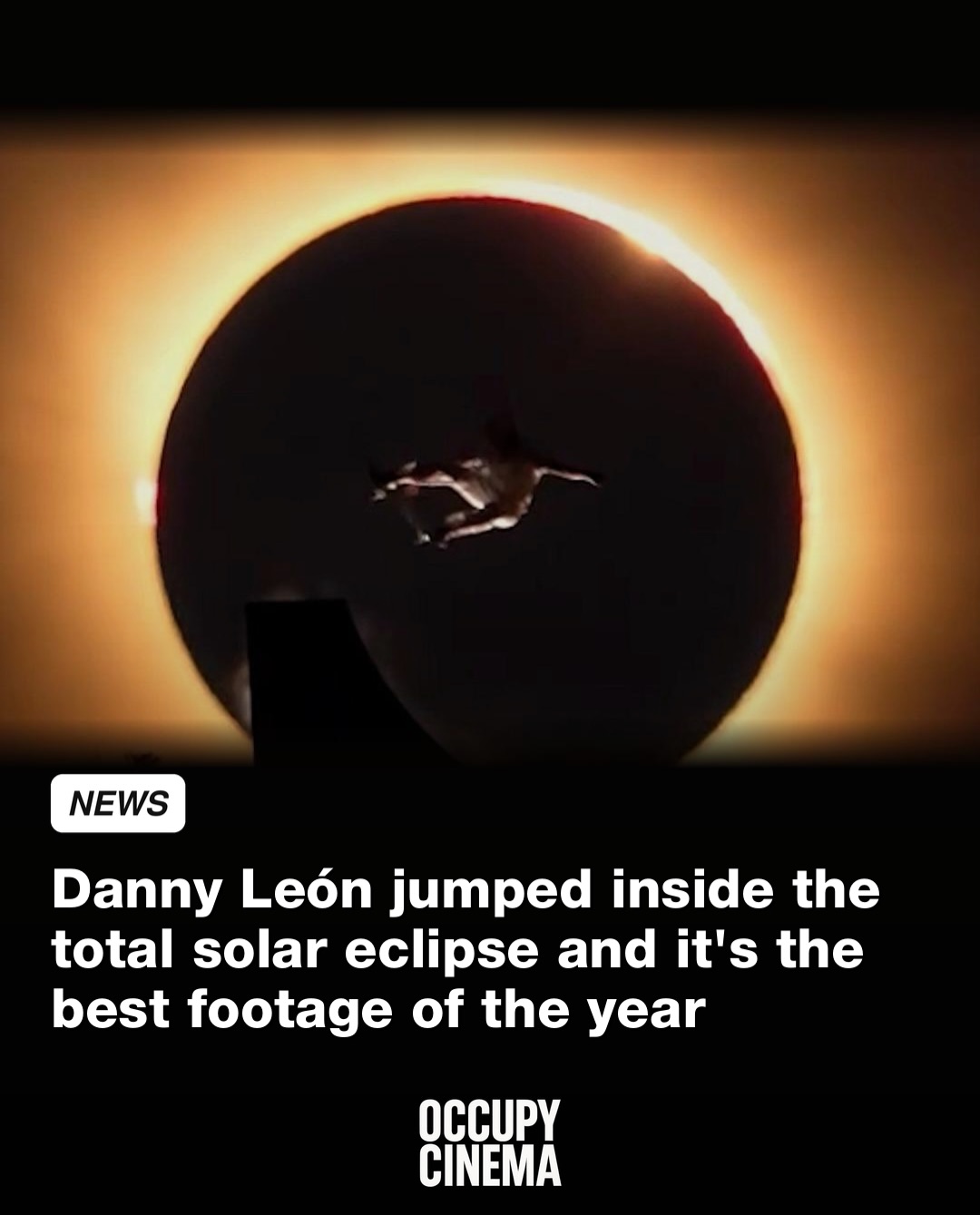
Capturing an image that occurs once every hundred years requires clinical precision and absolute technical discipline. Spanish Olympic skateboarder Danny León dropped in at the precise moment of totality during a recent solar eclipse in Spain, positioning his board directly within the darkened silhouette of the sun. The resulting footage, which León shared publicly, stands as a masterclass in extreme location production and high-stakes visual timing. It represents a rare convergence of elite athletic execution and rigorous practical filmmaking under severe time constraints.
The clip was captured by filmmaker Gonzalo De Vega alongside photographer Jose Izquierdo. Executing a frame like this leaves zero margin for technical error or miscalculation. In standard action sports cinematography, perfection comes through trial and repetition. Directors and camera operators routinely run through dozens of takes, adjusting camera angles, focal lengths, and lighting setups until the motion aligns with the frame. In this instance, the crew had exactly one window that lasted mere seconds. The mainland solar eclipse was Spain's first in over a century, offering no second passes and no room for equipment failure.
The Physics of One-Take Cinema
Action cinema relies heavily on precise exposure control, but tracking a fast-moving subject against a solar eclipse creates severe dynamic range challenges. Cinema camera sensors must contend with extreme shifts in ambient light as totality approaches, moving from blinding solar brightness to near-total shadow in a matter of seconds. De Vega and Izquierdo had to calculate optical filtration, depth of field, and camera elevation far in advance. Aligning León's drop-in trajectory with the sun required exact geometric placement of the temporary ramp relative to the fixed camera position on the ground.
This level of practical planning highlights a growing split in contemporary visual storytelling. While Hollywood blockbusters rely heavily on post-production visual effects and sky replacement tools, practical filmmaking under organic conditions creates a visceral impact that digital compositing rarely matches. As reported across industry trade coverage on film craft at IndieWire, the demand for authentic, unmanipulated visuals remains strong among audiences saturated with digital noise. A single frame recorded live during a celestial alignment carries an indisputable visual authority.
High Stakes in Action Sports Storytelling
For León, who represented Spain at the Tokyo and Paris Olympic Games, the stunt represented a high-water mark outside the competitive arena. León described the trick as the defining move of his career, acknowledging that the physical stunt was only half of the achievement. The rest belonged to the crew operating the lenses. Action sports cinematographers are accustomed to rapid tracking and handheld adjustments, but framing a high-speed trick inside a narrow astronomical window requires mathematical rigors combined with flawless physical timing.
The wider industry landscape in action sports media, frequently detailed by outlets like Variety, has increasingly shifted toward polished digital short-form content. Yet this project proves that physical location work paired with absolute environmental constraint yields the most compelling results. When natural phenomena and human physical skill intersect under tight technical controls, the resulting footage transcends standard sports coverage and becomes enduring cinematic art.
Ultimately, the success of the shoot rests on absolute preparation. Without the luxury of a second take, De Vega, Izquierdo, and León achieved what modern digital effects teams spend months trying to simulate in post-production. It serves as a reminder to filmmakers everywhere that real-world physics, sharp planning, and raw nerve can still capture moments that leave an indelible mark on visual culture.
Related reading: Reflections: Twenty-One Cinematographers at Work.