Occupy Cinema › FEATURED
Dubai International Film Festival Set for December 2027 Relaunch
Ten years after pausing operations, Dubai's premier cinematic showcase will return on December 8, 2027, reviving a critical regional marketplace and international festival bridge.
By Occupy Cinema ·
Ten years after quietly stepping back from the global festival circuit, the Dubai International Film Festival is officially returning. Mona Al Marri, Director General of the Government of Dubai Media Office, made the announcement during the Arab Media Summit. The festival will launch its fifteenth edition on December 8, 2027. The news marks the end of a long hiatus that left Arab cinema without one of its most potent commercial engines and red carpet destinations.
Founded in 2004, the Dubai festival spent fourteen annual editions establishing itself as the preeminent cinema event in the Middle East. It was built to bridge Western distribution with regional talent. The event quickly proved that the Gulf could host a world class gathering without relying solely on Hollywood imports. By combining high profile premieres with robust industry panels, the festival gave Middle Eastern filmmakers a direct channel to global sales agents, distributors, and critics.
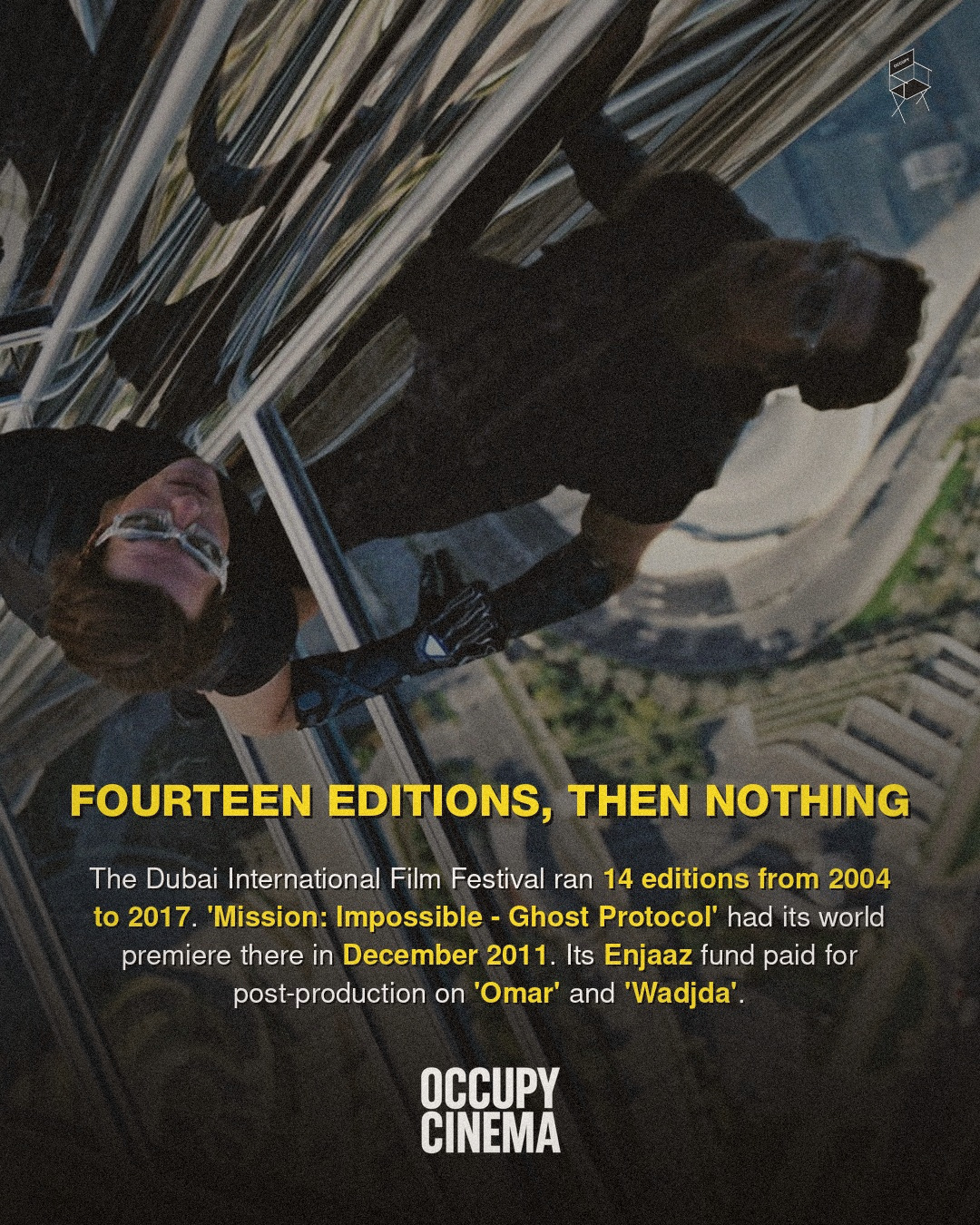
The festival made global headlines in December 2011 when Paramount Pictures chose Dubai for the world premiere of Mission: Impossible - Ghost Protocol. Director Brad Bird and star Tom Cruise descended on the city, backed by iconic stunt footage of Cruise scaling the Burj Khalifa. The film went on to generate $694 million worldwide. That moment cemented the event as a top tier platform capable of launching major studio blockbusters alongside delicate art-house fare. Industry trade Variety consistently highlighted the event as a critical bridge between Hollywood and MENA distributors.
Beyond the star-studded red carpets, the core engine of the festival was its Enjaaz fund. The initiative provided crucial post-production grants and development capital to regional filmmakers struggling to secure traditional financing. Enjaaz backed groundbreaking titles that achieved historic international success. Among them was Wadjda, directed by Haifaa Al-Mansour, which became the first feature film shot entirely inside Saudi Arabia. The fund also supported Omar, directed by Hany Abu-Assad, which won the Jury Prize at Cannes in Un Certain Regard and earned an Academy Award nomination for Best Foreign Language Film in 2014.
The Vacuum Left Behind
When organizers paused the festival after its 2017 iteration, the sudden closure disrupted the regional industry ecosystem. Middle Eastern filmmakers lost a vital co-production market and an essential networking hub. In the years following the hiatus, new regional players stepped into the spotlight to fill the opening. Saudi Arabia launched the Red Sea International Film Festival in Jeddah in 2021, backed by substantial state investment and the Red Sea Film Foundation. Meanwhile, established events like the Cairo International Film Festival and the El Gouna Film Festival continued to champion regional talent.
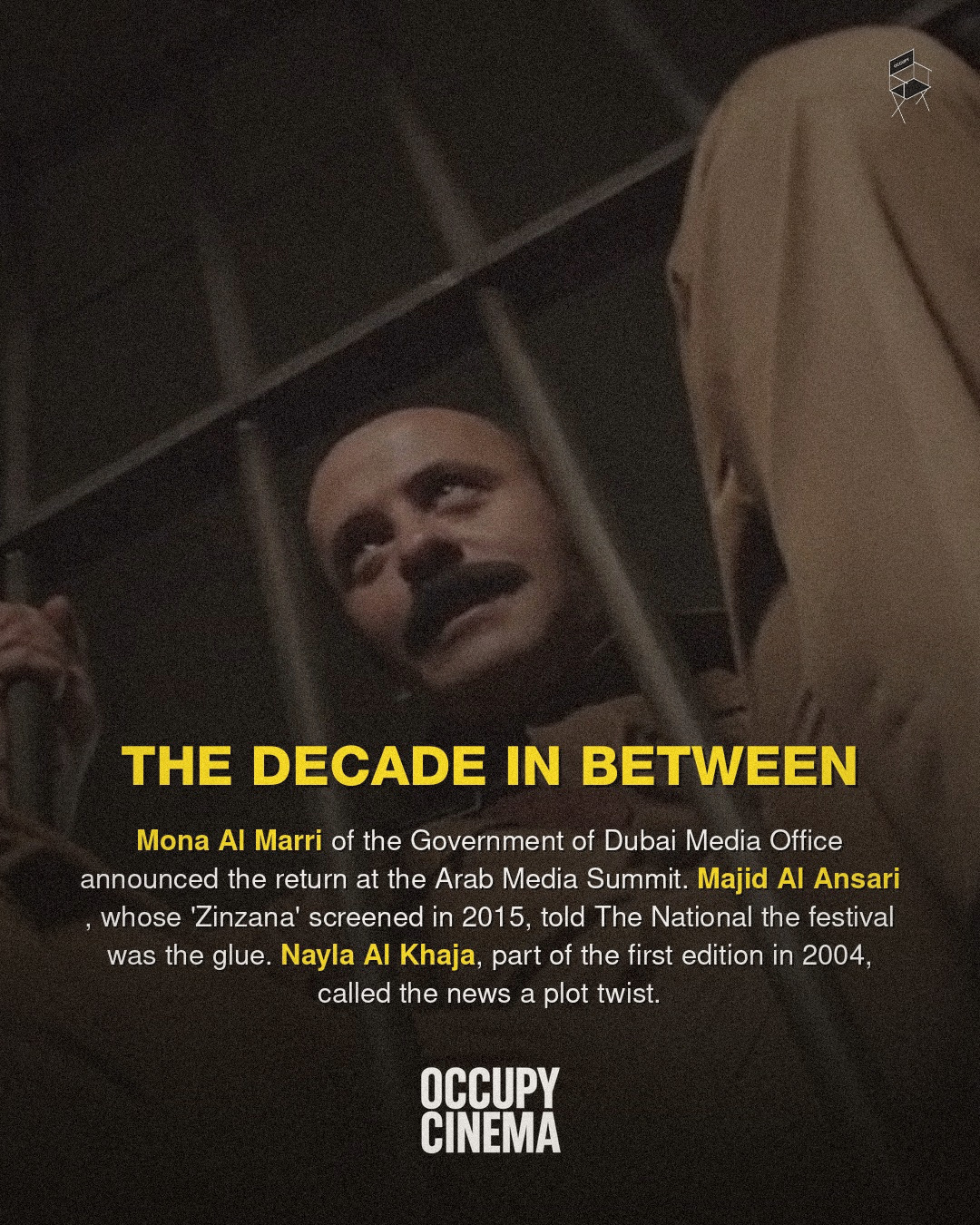
Yet the legacy of the Dubai festival remained unmatched in the eyes of many local creators. Emirati filmmaker Majid Al Ansari, whose acclaimed thriller Zinzana screened at the festival in 2015, reflected on the loss in an interview with The National. Al Ansari described the gathering as the glue that held the regional film industry together. It provided local writers, directors, and producers with a shared space to negotiate deals, find mentors, and present their work to international programmers who rarely visited the region outside of festival dates.
The absence of the festival coincided with a period of massive growth in local production infrastructure. Dubai Studio City and regional soundstages expanded rapidly over the last decade, accommodating large-scale commercial shoots and international television productions. At the same time, regional streaming services such as Shahid and Starzplay Arabia transformed viewer habits, driving up demand for original Arabic language content. As reporting from The Hollywood Reporter has documented, the MENA entertainment market expanded exponentially during this window, making the lack of a dedicated Dubai film market even more conspicuous.
The decision to schedule the return for December 2027 gives organizers a three-year timeline to rebuild the necessary physical and logistical infrastructure. Modernizing the festival will require re-establishing the Enjaaz fund for a new generation of creators working in digital and serialized formats. It will also require assembling a new executive programming team to interface with sales agencies across Europe, North America, and Asia.
A Strategic Pivot for 2027
Relaunching in 2027 positions Dubai to capture a shifting global film economy. Global distribution patterns have changed dramatically since 2017. The rise of direct-to-streaming models and theatrical window compression means film festivals are now more critical than ever as physical curation hubs. Independent projects rely heavily on festival launches to secure distribution deals in a crowded digital landscape. By establishing a firm return date, the Government of Dubai Media Office is signalling its intent to reclaim its central role in regional media trade. Coverage in Deadline underscores how regional festivals in the Middle East have increasingly become vital finance stops for international co-productions.
The landscape in 2027 will look vastly different from the environment of 2004 or 2017. Dubai will not operate in isolation. It will enter a competitive field alongside established events in Jeddah, Cairo, and Doha. However, Dubai possesses unique advantages, including top tier aviation connectivity, world class hospitality, and a proven track record of securing major studio premieres.
The return of the Dubai International Film Festival is more than a nostalgic revival. It is a calculated reinvestment in the commercial and artistic future of Arab cinema. By giving filmmakers a three-year runway, the festival aims to restore the vital bridge between Middle Eastern storytelling and global film markets. When the red carpet rolls out in December 2027, the region will finally reclaim one of its most important cultural institutions.