Occupy Cinema › FEATURED
Raw Nerve Cinema: How Kathryn Bigelow and 'The Hurt Locker' Rewrote Oscar History
Produced for a modest $15 million and shot under blistering conditions in Jordan, Kathryn Bigelow's tension-wire masterpiece rewrote the rules of war cinema and made Academy Awards history.
By Occupy Cinema ·
When the 82nd Academy Awards convened in March 2010, the industry narrative was framed as a box office showdown between massive spectacle and lean independent craftsmanship. On one side stood James Cameron with Avatar, a technological juggernaut that had erased global box office records. On the other stood Kathryn Bigelow with The Hurt Locker, a visceral, low-budget Iraq War drama that operated on nerves rather than digital imagery. By the end of the broadcast, Bigelow made history as the first woman to win the Academy Award for Best Director, with her film securing six Oscars in total, including Best Picture, Best Original Screenplay, and Best Film Editing.
The financial scale of the achievement remains stark. Made for just $15 million, The Hurt Locker took in roughly $49 million globally during its theatrical run. At the time, it was one of the lowest-grossing Best Picture winners in modern box office history. Yet its cultural footprint was seismic, entirely reshaping how Hollywood approached modern military conflict on screen. Where previous contemporary war films had stumbled by preaching to the audience, Bigelow delivered a sensory immersion into the lethal mechanics of bomb disposal.
The origin of the project traces back to screenwriter Mark Boal, who spent time embedded as a journalist with an American Explosive Ordnance Disposal team in Baghdad in 2004. Boal captured the hyper-specific dialect, psychological isolation, and mundane horror experienced by technicians whose daily job was disarming improvised explosive devices. Rather than constructing a conventional political allegory, Boal and Bigelow converted those real-world dispatches into a tight procedural thriller that treated every loose wire and distant balcony as a potential death sentence.
To capture the kinetic chaos of the setting, Bigelow enlisted British cinematographer Barry Ackroyd, known for his docudrama work with Ken Loach and Paul Greengrass. Shooting on Super 16mm film stock using handheld Aaton cameras, Ackroyd established a visual syntax that mirrored the disorientation of the battlefield. The production chose locations in Jordan near the Iraqi border, exposing the cast and crew to severe climate conditions where summer temperatures regularly crossed 120 degrees Fahrenheit. The punishing dust and physical heat translated directly onto the rough, granular images captured on camera.
Procedural Tension and the Physics of Uncertainties
The operational philosophy of The Hurt Locker relies on spatial paranoia. In traditional action cinema, spatial geometry is mapped clearly so the viewer understands safe zones and threat origins. Ackroyd deliberately inverted this convention by running up to four cameras simultaneously at varying focal lengths. Handheld units on the street level were paired with telescopic zoom lenses mounted on distant rooftops. Because the camera cuts between extreme close-ups of delicate wire cutters and grainy long-lens shots of anonymous bystanders watching from apartments, the viewer never learns where a safe distance resides.
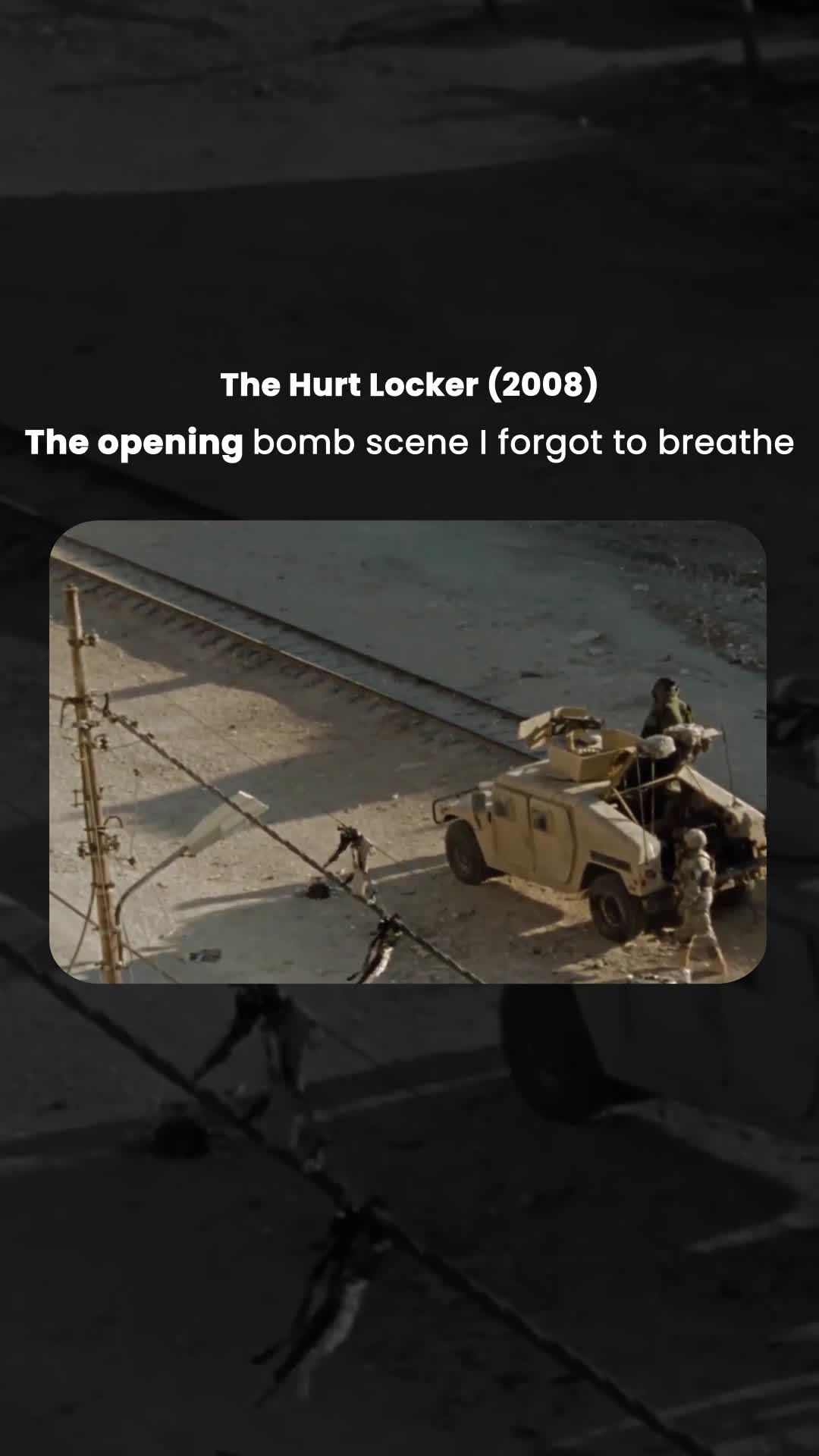
The film's opening sequence exemplifies this relentless pacing. Featuring an uncredited cameo by Guy Pearce as team leader Matt Thompson, the sequence builds tension over ten painful minutes without delivering a traditional heroic resolution. The scene details every mechanical step of operating a heavy bomb disposal suit and maneuvering a treaded reconnaissance robot. When a remote detonator triggers an explosion, the kinetic impact is felt in suffocating slow motion, proving early to the audience that no character enjoys plot armor.
Central to the film's success was the casting of Jeremy Renner as Staff Sergeant William James, a bomb technician who thrives on the terrifying high of his assignments. Before his casting, Renner was largely an under-the-radar character actor best known for indie projects like Dahmer. Bigelow resisted studio pressure to cast an established A-list star in the lead role, recognizing that an unfamiliar face was essential for maintaining grounded realism. Renner's performance earned him a Best Actor nomination and instantly repositioned his career trajectory, leading directly to high-profile franchise roles reported across major industry trades like The Hollywood Reporter.
Renner was matched by compelling performances from Anthony Mackie as Sergeant J.T. Sanborn and Brian Geraghty as Specialist Owen Eldridge. The friction between Sanborn's by-the-book survival instincts and James's reckless professionalism creates an internal war inside the unit. Their tactical interactions feel entirely earned, grounded in authentic military protocol that Boal observed firsthand in Iraq.
A Watershed Moment for Independent Cinema
The post-production phase was a massive editing task managed by Chris Innis and Bob Murawski. The pair was tasked with sifting through nearly 200 hours of raw footage gathered across the multi-camera setups in Jordan. Their work cut away cinematic flourishes, maintaining a jagged, nervous pulse that earned them the Academy Award for Best Film Editing. The sound team led by Paul N.J. Ottosson similarly earned twin Oscars for Sound Editing and Sound Mixing, utilizing silence, heavy breathing inside the heavy bomb suit, and distant desert winds to build auditory claustrophobia.
Distribution represented another significant hurdle. As detailed during the film's festival run covered by IndieWire, many distributors in 2008 were hesitant to pick up Iraq War projects after early titles like Redacted and Stop-Loss failed to attract mainstream audiences. Summit Entertainment eventually acquired the North American rights, launching a targeted platform release strategy in June 2009. Strong critical consensus sustained the film in theatres for months, building momentum that lasted all the way into awards season, where it dominated late-stage guild wins at the DGA and PGA.
Looking back at the theatrical ecosystem of 2008 and 2009, detailed in retrospective industry analyses on Deadline, The Hurt Locker remains a rare watershed moment where a small, intensely focused indie defeated high-budget studio fare at the highest level of recognition. The film avoided neat moral conclusions about conflict, opting instead to present an exacting study of compulsion under threat of annihilation.
Ultimately, The Hurt Locker proved that scale is not a prerequisite for cinematic power. By trading glossy Hollywood fireballs for tight close-ups on copper wires and sweating foreheads, Bigelow and her team created an enduring blueprint for tension that remains unmatched in modern action cinema.