Occupy Cinema › Film News
The Fine Art of Playing Straight to Felt: How Tim Curry Anchored Muppet Treasure Island
Decades before prestige actors struggled against green screens, Tim Curry treated Muppets like classical scene partners, delivering a masterclass in practical hybrid cinema.
By Occupy Cinema ·
In an era where A-list talent routinely struggles to project authentic emotion against empty blue screens, looking back at the practical hybrid filmmaking of the 1990s offers a sharp reminder of what full commitment looks like. Cinema history is littered with live-action actors who treated puppetry with condescending irony. The performers who endured, however, were the ones who treated foam, fleece, and latex as formidable scene partners.
In February 1996, Walt Disney Pictures and Jim Henson Productions released Muppet Treasure Island, directed by Brian Henson. Working with an estimated $31 million production budget, the film sought to replicate the theatrical prestige of 1992's The Muppet Christmas Carol. While it posted a modest domestic return of roughly $34 million according to historical box office tracking at The Hollywood Reporter, the movie quickly became a titan of physical home video sales and cable syndication. Its enduring shelf life relies heavily on one crucial creative pillar: the absolute sincerity of its human lead.
Method Acting in an Ocean of Foam and Fleece
Tim Curry stepped into the role of Long John Silver not as a pantomime guest star, but as a classical villain executing Robert Louis Stevenson. That level of dedication required adapting to unique on-set psychological conditions. The Henson company puppeteers, led by Frank Oz, Dave Goelz, and Steve Whitmire, maintained strict character immersion from the floorboards. Once a puppet was raised on an arm, the operator ceased talking as themselves; they addressed Curry exclusively in character between takes. Curry later described the sensation as distinctly spooky, a technical illusion so persistent that the line between operator and creation vanished on set.
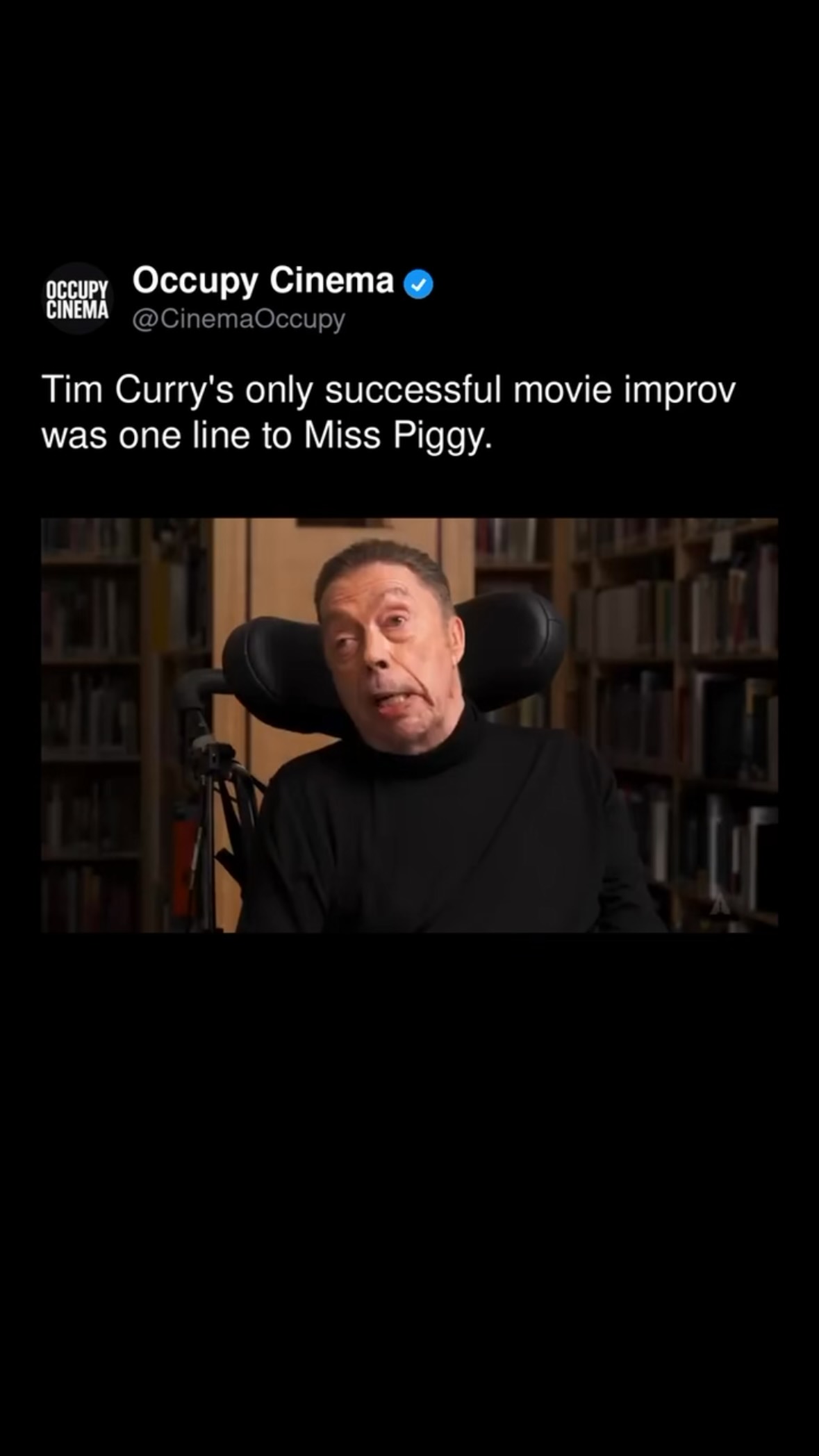
That psychological pressure cooker yielded spontaneous moments of brilliance. When Silver confronts Benjamina Gunn, the abandoned island queen portrayed by Miss Piggy, the script leaned heavily into their torrid romantic backstory. Curry seized the moment to improvise an infamous innuendo, declaring that once you have had pork, you never go back. Frank Oz did not break; Miss Piggy offered an icy, unamused glare that remained in the final edit. Curry later called it the only successful ad-lib of his screen career, preserved precisely because it pushed the adult absurdity of the scene without shattering the narrative world.
The Craft of Grounding the Unreal
The technical execution of the production demanded relentless precision. Cinematographer John Fenner had to light vast pirate galleons built four feet above the studio floor to accommodate puppeteer trenches, while composer Hans Zimmer delivered a sweeping swashbuckler score that treated the narrative stakes as lethal. Had Curry blinked, the high-wire act would have collapsed into self-parody. Instead, he met the energy of his non-human costars with theatrical grandeur, matching Kermit the Frog and Miss Piggy beat for beat in dramatic weight.
Today, as Hollywood reckons with the cold sterility of purely digital background characters, Curry's performance stands as a blueprint for fantastical worldbuilding. Believability does not originate inside a visual effects rendering suite; it begins with the human performer on the floor. The triumph of Muppet Treasure Island was never about hiding the seams, but about hiring an actor who treated felt creations like Royal Shakespeare Company veterans.
Related reading: Respect for Acting.