Occupy Cinema › Film News
Kathryn Bigelow Predicted Hollywood's Directing Deficit Decades Before Breaking Its Ceiling
Thirty-four years after Kathryn Bigelow pointed out Hollywood's lack of imagination, the numbers behind female directors remain an ongoing industry battleground.
By Occupy Cinema ·
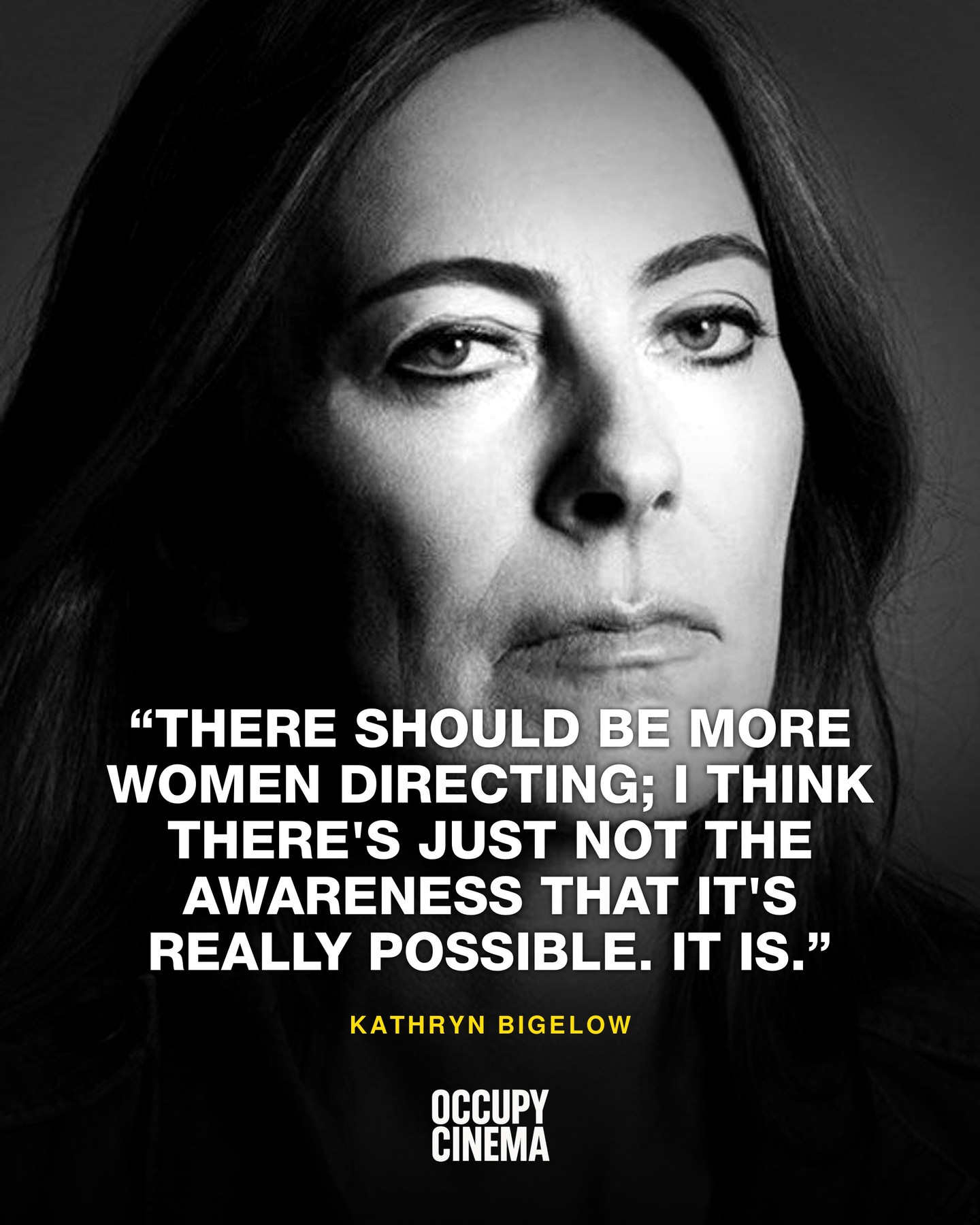
In 1990, fresh off the release of the gritty police thriller Blue Steel and gearing up for what would become the cult action benchmark Point Break, Kathryn Bigelow sat down with MIT's campus paper, The Tech. Her assessment of the industry was characteristically direct: "There should be more women directing; I think there's just not the awareness that it's really possible. It is." At the time, studio executive suites treated women behind the camera of high-octane genre pictures as anomalies rather than viable commercial assets. Bigelow did not simply identify the glass ceiling; she set about systematically dismantling it through pure kinetic craft.
Two decades after that interview, Bigelow made history at the 82nd Academy Awards by becoming the first woman to win the Oscar for Best Director for The Hurt Locker. Produced independently for roughly $15 million and distributed by Summit Entertainment, the film outmaneuvered massive studio juggernauts at the box office and on the awards circuit. It remains a watershed moment in contemporary film history, proving that low-budget tension and uncompromising physical realism could overpower nine-figure visual effects spectacles on Hollywood's grandest stage.
The Tactical Mechanics of Kinetic Cinema
Bigelow's legacy is defined by technical precision and immersive camera choreography. On The Hurt Locker, she paired with cinematographer Barry Ackroyd to deploy up to four Super 16mm cameras simultaneously in the blistering heat of Jordan. The production captured multiple perspectives of high-stakes bomb disposal sequences without relying on traditional coverage formulas. Editors Bob Murawski and Chris Innis turned hundreds of hours of raw footage into a fragmented, nerve-shredding study of adrenaline addiction. The result garnered six Academy Awards and reset the stylistic template for modern combat cinema.
Her follow-up, Zero Dark Thirty, generated over $130 million worldwide for Sony Pictures on a $40 million budget, reinforcing that commercially viable, morally complex political thrillers were well within her wheelhouse. Bigelow never allowed the industry to pigeonhole her output, leaning into propulsive sound design, naturalistic lighting, and visceral camera movement that forced audiences into the immediate psychological reality of her characters.
The Statistical Reality Decades Later
Despite Bigelow's breakthrough, the industry metrics she diagnosed in 1990 have shifted at an excruciatingly slow pace. Research tracks from outlets like The Hollywood Reporter and data from the USC Annenberg Inclusion Initiative routinely demonstrate that women still account for a stubbornly low percentage of top-grossing domestic directors. While subsequent historic wins by Chloé Zhao for Nomadland and Jane Campion for The Power of the Dog expanded the pantheon, parity remains elusive across mainstream theatrical distribution, as reported across Variety year-end analytics.
Awareness of what is possible has never been the bottleneck for filmmakers themselves. Instead, the friction lies within risk-averse financing structures and legacy studio gatekeeping. Bigelow proved the viability of female-directed genre cinema with cold, undeniable craft and critical hardware. The remaining challenge is ensuring the industry builds an infrastructure capable of backing that reality at scale.
Related reading: On Filmmaking.