Occupy Cinema › Craft
How Robert Elswit Built the Old Testament Visuals of 'There Will Be Blood'
Paul Thomas Anderson and cinematographer Robert Elswit relied on silence, 35mm film, and real fire to craft a timeless cinematic sermon on greed.
By Occupy Cinema ·
Paramount Vantage and Miramax invested a reported $25 million in Paul Thomas Anderson's 2007 period masterpiece There Will Be Blood. That investment yielded over $76 million in global box office returns, eight Academy Award nominations, and an indelible place in film history. Yet the true return on investment was artistic. The film transformed Upton Sinclair's 1927 socialist novel Oil! into an epic study of obsession, capitalism, and spiritual ruin.
The movie announces its narrative ambition in the opening minutes. For nearly a quarter of an hour, the story unfolds without a single line of spoken dialogue. Audiences follow prospector Daniel Plainview, portrayed by Daniel Day-Lewis in a performance that earned him an Oscar, inside a dark pit in New Mexico territory in 1898. Plainview breaks his leg in a shaft accident, hauls his broken body across miles of desert dirt, and claims his silver payout. The narrative relies entirely on mime, physical strain, and visual geometry, echoing the functional language of the silent film era.
Cinematographer Robert Elswit earned his Academy Award for Best Cinematography by framing this American expansion as an Old Testament nightmare. Shooting on 35mm film stock with Panavision Panaflex cameras, Elswit utilized anamorphic lenses alongside a century old Pathé camera equipped with a vintage lens to capture period accurate optical distortion during early mining shots. The desolate Texas landscape, filmed around the high desert town of Marfa, Texas, becomes a character in its own right. The camera frames human figures as tiny specks against vast stretches of sun bleached earth.
Constructing the Burning Derrick
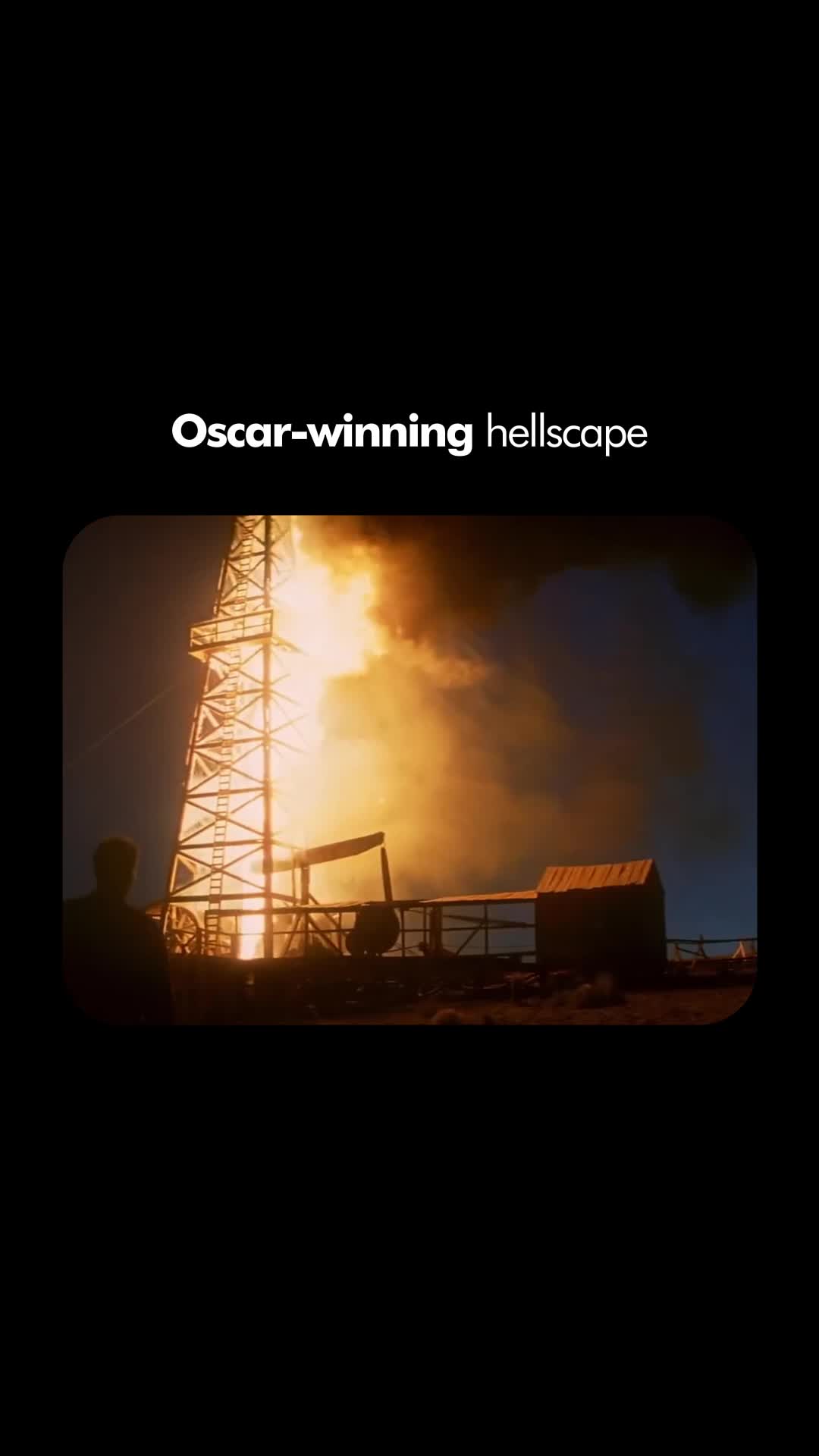
The technical centerpiece of the production remains the oil derrick fire at night. Rather than relying on computer generated imagery, the production built a working derrick rig and set it ablaze in controlled conditions. Elswit captured actual roaring flames surging into the dark Texas night sky while Day-Lewis stood silhouetted in oil and soot. Coverage from The Hollywood Reporter at the time noted the extreme physical demands placed on the crew during these nocturnal shoots.
The sequence gains its hypnotic power through the interplay of light and sound. Jonny Greenwood, lead guitarist for Radiohead, composed a dissonant, avant garde score that replaced traditional dramatic underscoring with screeching strings and percussive thrums. Coupled with Dylan Tichenor's taut editing, the derrick burning feels like an apocalyptic ritual. Elswit used the fire itself as the primary key light source, bouncing real flames across the black canvas of the desert night.
An Enduring Benchmark for American Cinema
During the 2007 awards circuit, trade journals like Variety recognized the film as a watershed moment for modern cinematography. Competing against visually stunning peers in a remarkable year for American cinema, Elswit's work stood out for its refusal to sanitize its environment. The lighting throughout the film remains diegetic, relying on oil lamps, torch flames, and harsh overhead sunlight to ground every scene in physical reality.
The hellscape that defines There Will Be Blood is never asserted casually or reduced to stylistic flair. It is constructed shot by shot through disciplined craft, mechanical patience, and tactile texture. In a contemporary media landscape increasingly dominated by slick digital aesthetics and blue screen backgrounds, Anderson and Elswit's analog achievement stands as a masterclass in visual storytelling.
Related reading: The Filmmaker's Eye.