Occupy Cinema › Craft
California Unveils First Standalone Post-Production Tax Credit Under AB 2319
Governor Gavin Newsom has signed Assembly Bill 2319, granting up to 50 percent back on post-production expenses in California without requiring projects to shoot in the state.
By Occupy Cinema ·

California is finally decoupling location shooting from post-production finishing work. On September 19, Governor Gavin Newsom signed Assembly Bill 2319 at the Television Academy in North Hollywood. The legislation establishes the state's first standalone tax credit dedicated entirely to post-production services. The policy returns between 35 percent and 50 percent of qualified expenditures incurred during picture editing, sound design, musical scoring, visual effects, and final color finishing. The critical clause in the bill fundamentally changes the economic calculus for major Hollywood studios. Productions no longer need to roll cameras inside California borders to claim state tax incentives for their post-production workflows.
For decades, Hollywood finance departments operated under a rigid mandate. If a studio filmed a blockbuster in Georgia, London, or Vancouver, the editorial and finishing work almost always followed the money. Sound editors in Burbank and visual effects artists in Santa Monica watched high-paying contracts migrate overseas. Foreign jurisdictions offered aggressive subsidy packages that made local finishing financially irresponsible on studio balance sheets. AB 2319 attacks that structural disadvantage directly. By offering up to 50 percent back on qualified local labor and facility costs, California is bidding aggressively for the lucrative finishing budgets of films and television series shot anywhere in the world.
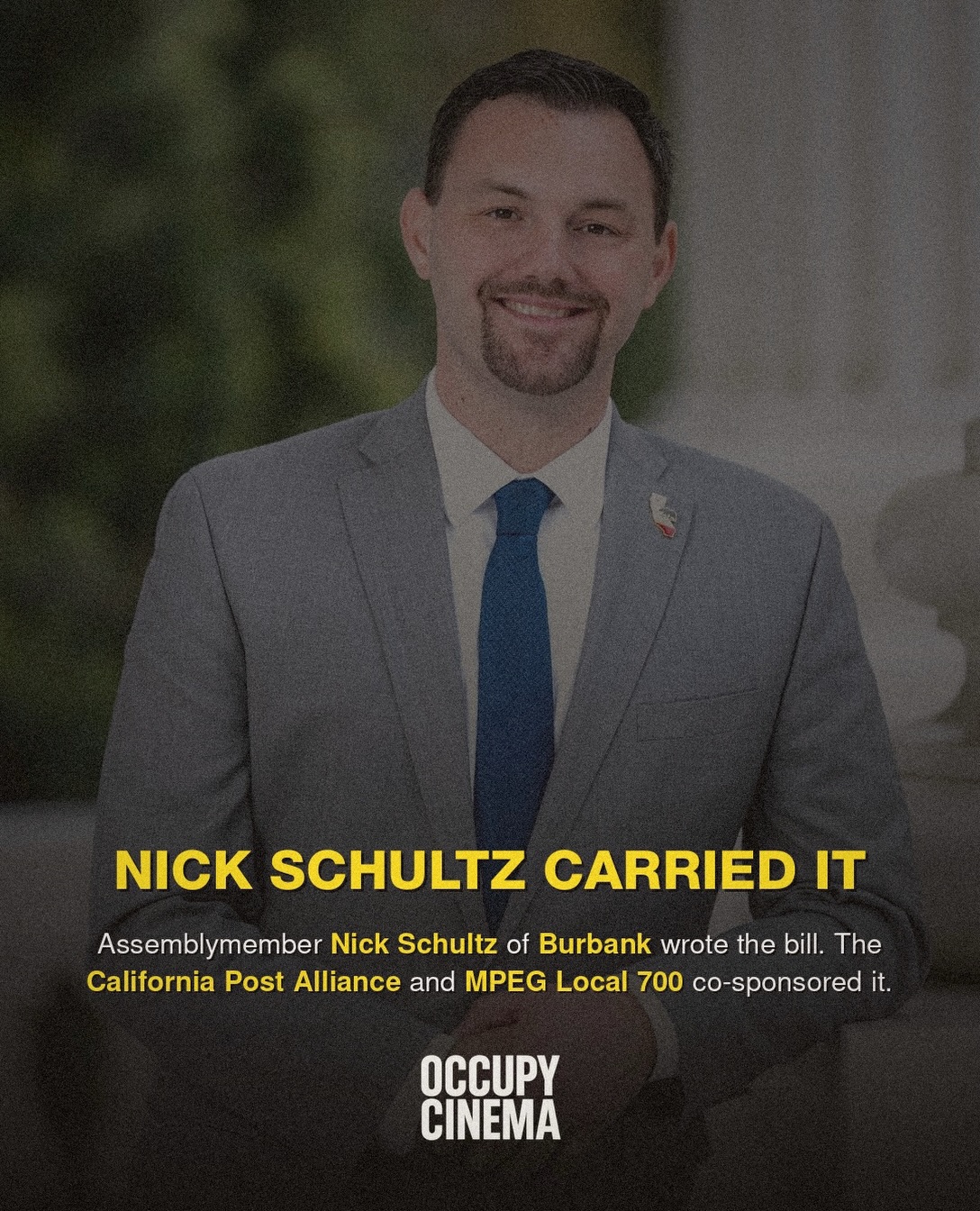
The bill was authored by Assemblymember Nick Schultz, whose district covers Burbank, the historic geographic center of studio editorial suites and post-production infrastructure. Schultz drafted the legislation to stem an ongoing drain of high-wage technical talent from Los Angeles County. Newsom signed the measure alongside Senate Bill 186, a companion piece of industry legislation set to take effect in 2027. While state officials have not yet finalized the explicit annual funding cap for the program, trade reporting from Deadline and The Hollywood Reporter indicates that this structural shift instantly reopens Southern California to major global studio pipelines.
Stopping the Post-Production Exodus
The historical context illustrates why this policy shift was long overdue. Under California's previous film tax credit frameworks, incentive points were strictly conditioned on principal photography days logged within state borders. Feature films that shot on stages in Pinewood Studios or on location in New Mexico were legally barred from leveraging California tax credits for their post-production phases. Consequently, directors like David Fincher and Christopher Nolan, who historically favored working with top-tier Los Angeles editorial and sound craftspeople, often faced intense corporate pressure to take their post-production packages abroad to maximize tax efficiencies.
Visual effects facilities bore the heaviest impact under the old regulatory model. Over the past fifteen years, major VFX houses either shuttered their California offices or migrated their core headcount to British Columbia, Quebec, and the United Kingdom. Canadian tax credit structures stacked federal and provincial incentives to cover up to 40 percent or more of digital artist labor. AB 2319 recalibrates this competitive environment. By establishing a baseline credit of 35 percent that scales up to 50 percent through targeted local hiring and regional diversity bonuses, California brings its net costs into direct parity with top foreign hubs.
Qualified expenses under AB 2319 cover virtually every technical phase that occurs after cameras wrap. The tax relief applies to picture editing, sound mixing, automated dialogue replacement (ADR), Foley recording, orchestral scoring, visual effects, animation finishing, and master deliverable creation. Musical scoring in particular has suffered massive losses to international scoring stages like London's Abbey Road. A potential 50 percent return on scoring sessions held inside local facilities provides an immediate boost for local studio musicians, sound engineers, and historic scoring stages across the Los Angeles basin.
The New Economics of Finishing in Los Angeles
The practical impact on studio greenlight decisions will be felt immediately. When line producers draft production budgets, post-production typically accounts for 15 percent to 30 percent of total spend on major studio tentpoles and high-end streaming series. Under the new guidelines, a 200 million dollar blockbuster shot entirely in Europe can now establish its picture editing department, sound design crew, and primary visual effects vendors in Los Angeles while claiming tens of millions in state rebates. Industry coverage from Variety highlights that this standalone mechanism eliminates the administrative friction of relocating physical production units simply to unlock post-production credits.
Senate Bill 186 complements this strategy by preparing the broader regulatory framework for 2027. Together, these legislative actions represent a coordinated effort to defend California's signature industry following a challenging period marked by labor strikes, corporate retrenchment, and aggressive tax competition from states like Georgia and New Jersey. By modernizing tax incentive structures, Sacramento recognizes that modern filmmaking relies heavily on digital post-production pipelines that operate independently of physical shooting locations.
For labor organizations like IATSE Local 700, the Motion Picture Editors Guild, the passage of AB 2319 provides vital economic momentum. Post-production workers faced chronic underemployment as global greenlights slowed and studios routed finishing work to foreign post hubs. The ability to pitch California facilities to global productions gives local crew members a powerful competitive advantage that no longer depends on local location permits or sound stage availability.
The long-term success of AB 2319 will depend on final budget allocations and administrative execution details. However, the legislative intent is entirely clear. California is no longer willing to cede its post-production ecosystem to foreign tax havens. By uncoupling editorial rebates from physical camera placement, the state has delivered a pragmatic, numbers-first policy that directly targets how modern entertainment is budgeted, edited, scored, and delivered.